
Consensys가 구축한 선도적인 자기 보관형 암호화폐 지갑이자 Web3로 가는 관문입니다.
모든 글 읽기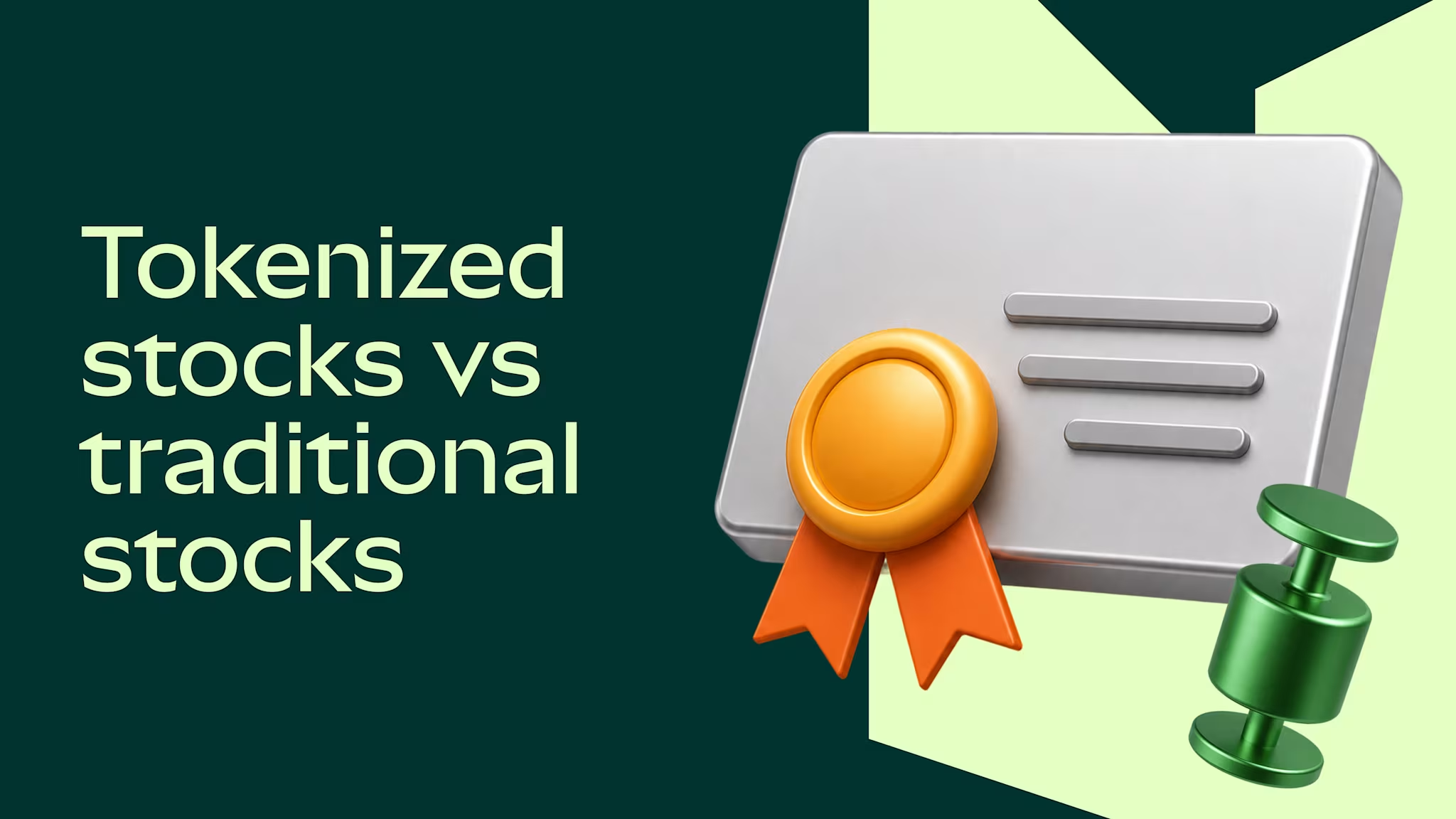
Key takeaways about tokenized stocks vs traditional securities
Traditional stocks confer direct ownership with binding voting rights. Tokenized stocks provide economic exposure to the same company, but the holder doesn't own the underlying share.
Voting works differently. Traditional shareholders cast binding proxy votes. Tokenized stockholders can submit preferences, but the issuer decides how to vote.
Dividends aren't paid out separately on tokenized stocks. Ondo Global Markets tokens reinvest dividends into the token's value automatically.
SIPC protects traditional brokerage accounts up to $500,000. No equivalent protection exists for tokenized equity holdings—protection depends on the custodian.
Tax reporting is simpler with traditional stocks. Tokenized equities add cost basis tracking, wash sale ambiguity, and evolving IRS requirements that brokerages don't handle.
A tokenized stock is a blockchain-based token that provides economic exposure to a publicly traded company's share price and dividends, without conferring direct ownership of the underlying share. The token is issued by a custodial entity that holds the real shares and passes through economic returns—typically as a total-return tracker that reinvests dividends into the token's value.
A traditional stock is a direct ownership interest in a company, recorded by the Depository Trust and Clearing Corporation (DTCC) and held through a brokerage. It confers voting rights, dividend payments, and regulatory protections including Securities Investor Protection Corporation (SIPC) coverage.
Both track the price of one company. One share of Apple held through a brokerage and one tokenized Apple token both move with Apple's market price. But tracking a price and conferring ownership rights are two different things—and the gap between them affects voting, dividends, tax reporting, and investor protection.
That difference matters most in three places: what happens when the company holds a shareholder vote, how dividends get distributed, and what protections exist if the entity holding the shares fails. This article covers those equity-specific mechanics. For a broader comparison covering bonds, real estate, commodities, and fund shares, see tokenized real-world assets vs traditional securities. For a comprehensive guide to how RWA tokenization works—including legal structures, custody, and yield mechanics—see tokenized real-world assets explained.
Disclaimer: This guide is for educational purposes only. It is not financial advice, not a solicitation, and not for UK audiences. Tokenized stocks and traditional securities are risky and not suitable for all users. Tokenized equities provide economic exposure, not direct share ownership. Not available to US users.
How ownership of stocks works
Traditional stocks: direct ownership
A traditional stock is a legal ownership interest in a company. The share exists as an entry in a ledger maintained by the Depository Trust and Clearing Corporation (DTCC), and the holder has a beneficial interest through their broker. That interest comes with specific rights: voting on corporate matters, receiving dividends, and claiming a proportional share of residual assets if the company is liquidated.
Brokerages hold shares on behalf of the owner in "street name," but the beneficial ownership—and the rights attached to it—belongs to the holder. If the broker fails, the Securities Investor Protection Corporation (SIPC) covers securities and cash up to $500,000, including a $250,000 limit on cash.
Tokenized stocks: economic exposure through a custodian
Most tokenized equity tokens don't represent direct share ownership. They represent a claim on shares held by a custodial entity—typically a special purpose vehicle (SPV) or an issuer like Ondo Global Markets. The token tracks the share price and captures economic benefits (including reinvested dividends), but the legal relationship runs through the issuer, not directly to the company.
Ondo Global Markets, which powers tokenized equity access through MetaMask across supported regions, states this directly in its documentation: each token is fully backed by the corresponding stock or ETF, but the tokens are distinct from the underlying shares and do not confer shareholder rights to token holders. For a walkthrough of how tokenized stocks work within MetaMask—including trading hours, fees, and swap mechanics—see the MetaMask Help Center guide to tokenized stocks.
This structure has a practical consequence: the holder's protections depend on the custodian and the legal wrapper, not on the regulatory framework that protects traditional shareholders. SIPC doesn't apply to tokenized equity holdings. If the custodial entity fails, recovery depends on bankruptcy remoteness provisions and the enforceability of the token holder's claims in the relevant jurisdiction. For a detailed due diligence checklist on evaluating custodian structures and legal wrappers, see how to verify RWA tokens.
Voting rights and corporate governance of traditional stocks vs tokenized stocks
This is where the equity-specific difference is sharpest.
Traditional stocks
Holders of traditional shares have the right to vote on corporate matters—board elections, executive compensation, mergers, and other proposals put to shareholder vote. Voting is typically handled through proxy: the brokerage sends proxy materials before a shareholder meeting, and the holder submits votes electronically or by mail. The vote is binding. The holder's preference is counted directly in the final tally.
Tokenized stocks
Because the issuer—not the token holder—is the beneficial owner of the underlying shares, voting works differently. Historically, most tokenized equity platforms didn't offer any voting mechanism at all. Token holders got price exposure and dividend equivalents, but no say in corporate governance.
That changed in April 2026, when Ondo Finance partnered with Broadridge Financial Solutions to enable holders of more than 250 tokenized stocks and ETFs to submit voting preferences through Broadridge's ProxyVote platform. Token holders can now review prospectuses, regulatory filings, and governance materials, then submit their voting preferences using a wallet signature.
The distinction matters: these are preferences, not proxy votes. Ondo, as the legal owner of the underlying shares, receives the token holders' stated preferences and decides how to vote. There's no legal obligation in the current structure for Ondo to follow those preferences—though the system is designed to create transparency around governance participation. As Ledger Insights reported in April 2026, the voting capabilities are "rights to express preferences to the issuer of Ondo GM Tokens regarding voting of the shares that the issuer beneficially owns."
For governance-sensitive holders, this is a meaningful gap. A traditional shareholder's proxy vote is counted in the final tally. A tokenized stockholder's preference is advisory input to the entity that actually votes.
For market size data and a breakdown of all tokenized asset categories—including equities, Treasuries, credit, and commodities—see RWA categories in 2026.
Dividend mechanics of traditional stocks vs tokenized stocks
Traditional stocks
Dividends follow a standardized process. The company declares a dividend with an ex-date (the date after which new buyers don't receive the dividend), a record date, and a payment date. The brokerage handles everything automatically—identifying eligible holders, calculating the per-share amount, and depositing cash (or additional shares for stock dividends) into the holder's account. For US tax purposes, the brokerage classifies the dividend as qualified or ordinary and reports it on the holder's 1099-DIV.
Tokenized stocks
Ondo Global Markets tokenized stocks handle dividends differently from traditional brokerages. Rather than paying dividends out as cash or stablecoin, Ondo's tokens are designed as total-return trackers—dividends are automatically reinvested into the token's value, net of applicable withholding taxes. The token price reflects both price movements and reinvested income, meaning a single token may come to represent more than one underlying share over time.
These features have two practical consequences for equity comparison. First, there's no separate dividend event to manage. Traditional brokerage holders receive cash deposits on payment dates and choose whether to reinvest. With tokenized equities, reinvestment is automatic and baked into the token's value—simpler operationally, but it removes the option to take dividends as cash. Second, the tax treatment is less clear.
Traditional brokerages classify each dividend as qualified or ordinary on a 1099-DIV. With total-return reinvestment, the dividend isn't received as a separate taxable event—it's embedded in the token's value. The IRS hasn't issued specific guidance on how to report reinvested dividend value within a tokenized equity's total return, and whether any portion qualifies for the lower qualified dividend tax rate remains unresolved.
Tax reporting: where the complexity compounds
Both tokenized and traditional equities are treated as capital assets in most jurisdictions—capital gains, dividend income, and loss deductions follow the same basic framework. The divergence is in reporting mechanics, and for equity traders specifically, three gaps stand out.
Automated vs manual reporting. Traditional brokerages track cost basis, classify dividends, apply wash sale rules, and issue 1099 forms automatically. Tokenized equity transactions are recorded onchain but require manual tracking or crypto tax software to interpret. For a full breakdown of IRS reporting requirements, 1099-DA rules, and cost basis tracking for digital assets, see US crypto tax reporting in 2026.
Wash sale ambiguity. Wash sale rules disallow loss deductions on substantially identical securities repurchased within 30 days. The IRS hasn't clarified whether a tokenized equity token is "substantially identical" to the traditional share it tracks. If they are, selling a tokenized Apple token at a loss and buying traditional Apple shares within 30 days could trigger a disallowance—but this hasn't been tested or formally addressed. Traditional brokerage accounts apply wash sale rules automatically; the tokenized side has no automated mechanism and an unresolved regulatory question.
Dividend tax classification. Traditional brokerages may report dividends and, when applicable, their qualified or ordinary status on tax forms such as Form 1099-DIV. Ondo Global Markets tokens use a total-return model where dividends are reinvested into the token's value rather than distributed separately. The IRS hasn't issued guidance on how to report the dividend component embedded in a total-return token's price appreciation—whether any portion qualifies for the lower qualified dividend rate, or whether the entire gain is treated as capital appreciation at disposition. Until that's resolved, the tax treatment of the dividend component remains ambiguous in a way that traditional brokerage dividends aren't.
Infrastructure differences
Settlement, trading hours, and fractional ownership differ between tokenized and traditional equities at the infrastructure level. These differences apply broadly across all tokenized assets—not just stocks. For a full treatment, see tokenized real-world assets vs traditional securities. The equity-relevant summary:
Traditional US equities settle T+1—one business day after the trade—under SEC rules effective May 28 2024. Tokenized equities settle onchain in minutes. Traditional markets operate 9:30 am–4:00 pm ET, Monday through Friday. Ondo Global Markets tokenized equities are available to trade on a 24/5 schedule—Sunday 8:00 pm to Friday 7:59 pm ET—with liquidity and pricing aligned to US market activity. Tokens can technically be transferred onchain at any time, but quotes through MetaMask are unavailable outside Ondo's designated trading windows. Fractional ownership is native to tokenized equities at the protocol level; traditional fractional shares are broker-dependent and may involve pooled account structures.
For traders outside the US who lack access to US brokerage accounts, tokenized equities are accessible globally through a self-custodial wallet, subject to regional availability. MetaMask RWAs, powered by Ondo Global Markets, provide self-custodial access to over 430 tokenized stocks, commodities, funds, and ETFs across supported regions.
Liquidity and spreads
Traditional equity markets have deep liquidity. Large-cap US stocks trade billions of dollars in daily volume on venues connected through the National Market System. Spreads on names like Apple or Microsoft are typically fractions of a cent.
Tokenized equities are a smaller market. The tokenized equities sector reached approximately $963 million in value as of January 2026, according to a DL News analysis of onchain data—a roughly 2,878% year-over-year increase from approximately $32 million in January 2025, but still a fraction of traditional equity volume. Ondo's roughly $700 million in tokenized stock and ETF assets under management as of early 2026 represents about 70% of the tokenized equities sub-sector.
Spreads on tokenized equities are wider than their traditional counterparts. The gap varies by token and platform—higher-volume names like tokenized Apple or Nvidia tend to have tighter spreads than lower-volume names. For large positions, traditional markets remain mechanically superior on execution quality. For smaller retail positions, the spread difference may be acceptable depending on the specific token.
Composability with blockchain protocols
Composability with onchain protocols is a key feature of tokenized equities. Traditional shares held in a brokerage exist in a closed system. They can't interact with decentralized finance (DeFi) lending protocols, serve as collateral for borrowing on blockchain networks, or plug into other blockchain-based applications. The brokerage is the boundary.
Tokenized equities live on blockchains and can potentially interact with other protocols. In theory, a tokenized Apple token could be deposited as collateral in a lending protocol to borrow stablecoins, serve as the underlying for a derivative contract, or interact with other DeFi (decentralized finance) applications that accept ERC-20 tokens.
This composability is emerging, and depends on the specific token's smart contract design, the protocol's acceptance criteria, and the regulatory status of using equity tokens as DeFi collateral. It isn't widely available today. But it represents a structural capability that traditional equities don't have—and for traders building onchain financial strategies, it could matter as the infrastructure matures.
Side-by-side comparison of traditional stocks vs tokenized stocks
Feature | Traditional stocks | Tokenized stocks |
Ownership structure | Direct beneficial ownership via broker | Economic exposure via custodial entity |
Voting rights | Binding proxy vote counted in tally | Preference submission; issuer decides (as of April 2026 via Broadridge) |
Dividends | Cash or shares, automated by broker, qualified/ordinary classification | Reinvested into token value (total-return tracker); no separate cash distribution; tax classification unresolved |
Investor protection | SIPC coverage up to $500,000 | Depends on custodian legal structure and solvency |
Corporate actions (splits, mergers) | Automated by broker and transfer agent | Handled by token issuer; mechanism varies |
Tax reporting | Broker-issued 1099 with cost basis and wash sale tracking | Manual or crypto tax tools; 1099-DA; wash sale treatment unresolved |
Settlement, hours, and fractional access | T+1 settlement; 9:30 am–4:00 pm ET Mon–Fri; broker-dependent fractional shares | Onchain settlement in minutes; 24/5 via Ondo (tokens transferable 24/7); native fractional ownership at protocol level |
Global access | Restricted by jurisdiction and broker availability | Broadly accessible via wallet (not available to US users) |
Liquidity | Deep markets; fractions-of-a-cent spreads on large caps | Thinner; wider spreads; growing but sub-$1 billion sector as of early 2026 |
Composability | None; closed brokerage system | Potential interaction with DeFi protocols (emerging) |
When each format may fit
For portfolios prioritizing deep liquidity, automated tax reporting, and established investor protections, traditional equities offer mechanical advantages. SIPC coverage, binding proxy voting, and automated dividend classification reduce operational overhead. Large positions benefit from market depth that absorbs orders without material slippage.
For traders outside the US who lack brokerage access to US equities, tokenized stocks fill a structural gap—accessible globally through a self-custodial wallet. Extended trading hours (24/5 through Ondo Global Markets) allow response to after-hours earnings releases and pre-market news outside traditional market windows. Native fractional ownership supports diversified allocations with limited capital. Onchain composability opens future possibilities that traditional brokerage accounts can't offer.
Neither format is universally superior. The tradeoffs depend on jurisdiction, position size, governance sensitivity, tax complexity tolerance, and custody preferences.
Explore 430 tokenized assets that are available for self-custodial trading, with 150+ tokenized stocks, via MetaMask.
- MetaMask

- 개발자
Agentic wallet security: how AI agents can transact with less risk
Agent wallets face prompt injection, key exposure, and permission risk. Here's how wallet isolation and spend limits minimize risk.
- 가이드
What is Hyperliquid?
Hyperliquid handles ~$195 billion in 30-day perpetual futures volume across 350+ markets. built on a custom blockchain. Learn how Hyperliquid works, how to trade on it, and how it ranks versus competitors.
- 가이드

How prediction market pricing works: from shares to resolution
Learn how prediction market shares reflect probability, how CLOB order books move prices, what happens at resolution, and when markets misprice.
