
ConsenSysが構築した、Web3への入口となる主要なセルフカストディ型暗号資産ウォレット。
すべての記事を読む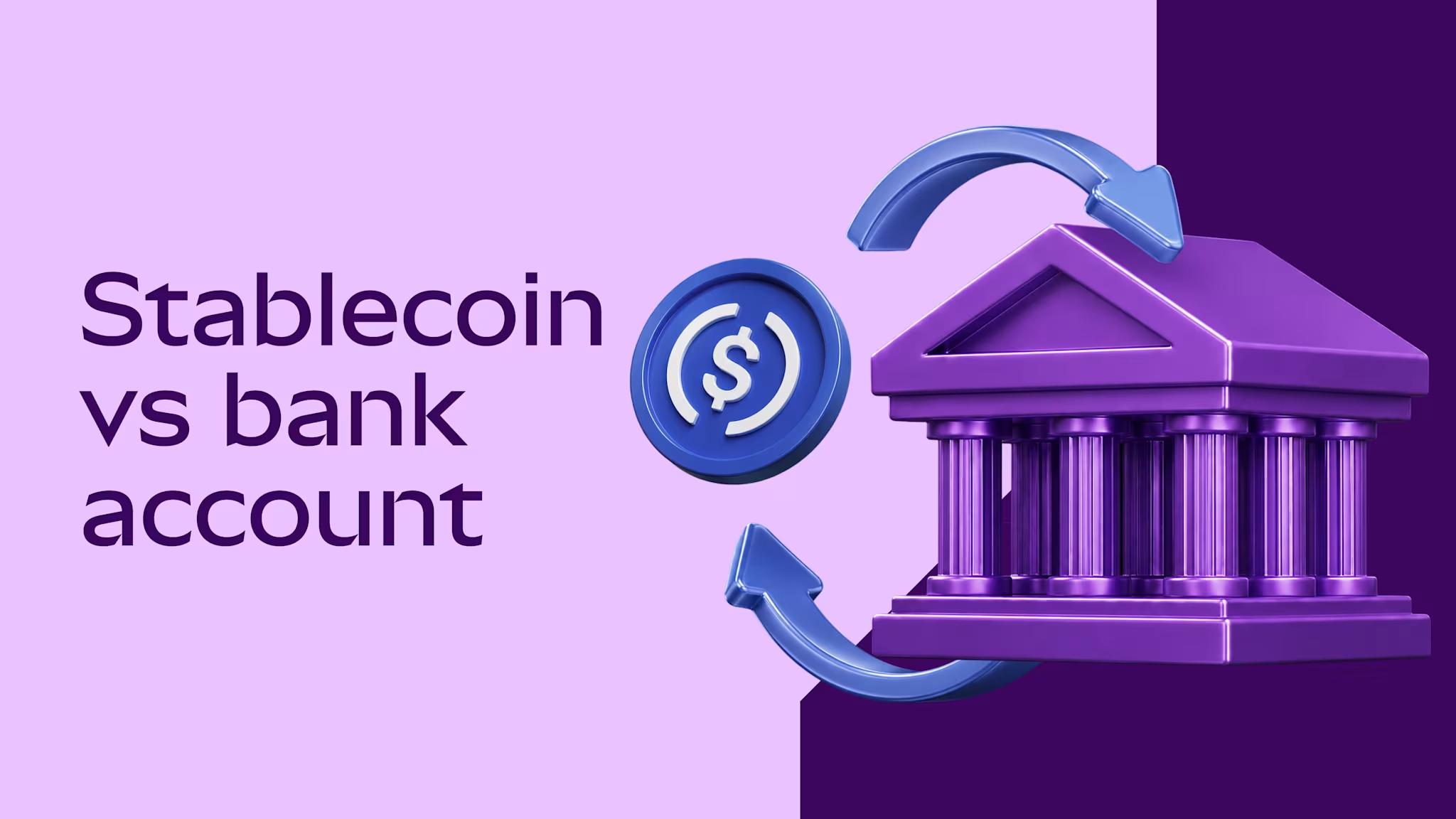
A bank account holds deposited fiat currencies at a traditional financial institution that manages custody and settlement through centralized rails. A stablecoin is a fiat-pegged digital token held in a crypto wallet and settled on blockchain networks.
Both hold fiat-denominated value, but the infrastructure differs. Stablecoins are maintained at their target value by being backed with reserves, collateral, or algorithmic mechanisms depending on their design. Stablecoins settle continuously on public networks, can be held directly by the holder or through a custodian, and move across borders on the same rails they use domestically. Bank accounts connect holders to traditional financial (TradFi) spending tools and, in many countries, are protected by government deposit insurance. This article compares the two across protection, yield, speed, access, and use cases, so the tradeoffs are clear wherever a reader is based.
Disclaimer: This guide is for educational purposes only. It is not financial advice, not a solicitation, and not for UK audiences. Stablecoins are risky and not suitable for all users.
How bank accounts work
A bank account is where a customer deposits money. Once deposited, it becomes a balance the bank owes back to the account holder. The bank controls and lends that money, agrees to return it on demand or on set terms, and connects the account to the wider TradFi banking system.
Bank accounts come in 4 common types, each one designed with different purposes.
Current or checking account: also called a transaction account, built for everyday spending and moving money, usually pays little or no interest.
Savings account, holds money set aside, pays interest, keeps funds accessible.
Money market account, mainly a US term, a savings-style account that can pay more and allow limited checks.
Certificate of deposit, known as a term deposit or fixed deposit in many countries, locks funds for a set period at a higher fixed rate.
The account type determines how quickly money can be accessed and how much it earns.
A traditional bank typically holds its own license and runs physical branches. However, many digital banks and money apps run on a partner bank's infrastructure or under e-money rules. This can impact deposit protection.
Many countries protect bank deposits through insurance or guarantee schemes, repaying a customer's money up to a cap if the bank fails. Examples of deposit coverage at regulated banks in 2026:
United States: $250,000 per depositor
European Union: €100,000 per depositor
United Kingdom: £120,000 per depositor
Japan: ¥10 million per depositor
Singapore: S$100,000 per depositor
Canada: C$100,000 per depositor
Australia: A$250,000 per account holder
Hong Kong: HK$800,000 per depositor
Deposit schemes aren't universal, and 77 countries currently operate without explicit deposit insurance schemes.
Interest is set by the bank and generally tracks the local central bank benchmark. For example, in the US, the FDIC national average savings rate is 0.38% as of June 2026, and high-yield accounts advertise roughly 3.8%–4.2%. Similar gaps appear in many markets.
How stablecoins work
A stablecoin is a digital token designed to hold a steady value, usually one unit of a fiat currency, such as the US dollar or euro. Instead of sitting in a bank, it is held in a crypto wallet, and holds its peg through a combination of backing and a self-correcting mechanism called an arbitrage loop. If the price drops below $1, traders buy the cheap token and redeem it at face value, pushing the price back up. If it rises above $1, new tokens are minted and sold, pushing it back down. The loop holds as long as the reserves are real and the redemption process functions.
Stablecoins have grown into a market of around $310 billion as of mid-2026, according to DefiLlama, with dollar-pegged tokens making up the large majority. This guide keeps the description brief; for the full mechanics of how a stablecoin holds its peg and what backs it, see how stablecoins work.
Where a stablecoin sits is a separate choice from the token itself. It can be held in a self-custodial wallet (where the owner has full control over funds, like MetaMask) or in a custodial wallet on an exchange or platform. Historically, a stablecoin sitting in a wallet earns nothing; earning a return is a separate step, covered in the yield section below. The same token can also run on multiple blockchains, each with different speeds and fees; for a full breakdown, see how stablecoins work.
Stablecoin types and why the type matters
Stablecoins come in a few common types, and the type shapes how each holds its value:
Fiat-backed tokens such as USDC and USDT hold cash and cash-equivalent reserves.
Crypto-backed tokens such as DAI lock more crypto collateral than the tokens they issue.
Algorithmic stablecoins use supply mechanics and have a more variable record.
The type determines how the peg is maintained; how stablecoins work covers the mechanics in full.
Key differences between stablecoins and bank accounts
Feature | Bank account | Stablecoin |
What it is | An account at a bank or similar regulated provider where money is deposited, such as a savings account | |
Who holds the funds | The bank, on the holder's behalf | The holder in a self-custodial wallet, or a custodian if held on a platform |
Access requirements | Identity checks (KYC), documentation, and approval | An internet connection and a wallet |
Availability | Varies by country and residency | Global access by default |
Hours | Increasingly 24/7 on instant payment rails in many countries | 24/7, every day of the year |
Protection model | Government deposit insurance of deposited funds, where available | Reserve backing or collateral, set by the issuer's design |
Default yield | Interest set by the bank | None by default; earning is an added step, now available fully liquid with Money Account |
Programmability | Limited to the bank's own features | Programmable through smart contracts |
Everyday spending | Cards, bill pay, direct deposit, and ATMs | Crypto-linked cards like the MetaMask Card, plus direct wallet transfers |
Transfer speed | Instant domestically on modern rails; ~1 to 5 days cross-border | Seconds to minutes, domestic or cross-border |
Stablecoin rewards vs savings account interest
Both bank accounts and stablecoins can produce a return, and both returns are variable. Bank interest rates commonly move with the local central bank benchmark, standard accounts typically pay well under 1%, high-yield accounts may pay more. A stablecoin typically earns nothing by default sitting in a wallet; a return comes from putting it to work.
Where stablecoin yield comes from
Stablecoin returns typically come from lending tokens to borrowers, supplying onchain liquidity, or depositing into a protocol that pays a market-set rate. Rates are variable and not guaranteed. The rate tracks borrowing demand, not central bank policy, so it moves independently of savings rates. MetaMask's self-custodial Money Account is an alternative way to earn on stablecoins. It is a one single, fully liquid account powered by mUSD, MetaMask’s dollar-backed stablecoin. The balance grows automatically as you trade, send, and spend, offering up to 6% APY until August 7th, and up to 4% APY after that.
The table below captures general examples as of mid-2026.
| Bank account | Stablecoin | Money Account |
Typical yield range | US ~0.38%, higher on high-yield accounts; varies by country | ~3% to 5%, varies by product and protocol | Up to ~4% APY on mUSD, up to 6% APY in the first month |
Rate type | Variable, set by the bank | Variable, set by the market | Variable and not guaranteed, moving with the market |
Rate driver | Central bank policy: US Federal Reserve, EU ECB, Japan Bank of Japan | DeFi borrowing demand | DeFi lending, through third-party platforms that deploy the underlying mUSD |
Protection | Deposit insurance: US FDIC $250k, UK FSCS £120k, Japan DICJ ¥10M | No deposit insurance; mUSD is backed 1:1 by US dollars and short-term US Treasuries in regulated custody | |
Minimum hold period | None for on-demand accounts; fixed-term products like US CDs lock funds for a set term | None to hold or transfer; some earn products apply a lockup or unstaking period | None; no lockups or minimums, fully liquid |
Tax treatment | Interest usually taxed as income | Income or capital gains determined by country | Income tax determined by country |
Stablecoin reserves vs bank deposit insurance
Bank deposits and stablecoins use different protection models, each with its own considerations. Bank deposit insurance is a government guarantee: if an insured bank fails, depositors receive their covered funds, usually within days. That protection is capped, does not exist in every country, and applies to deposited funds rather than to investments or other holdings.
Stablecoins rely on reserves or collateral instead of a government guarantee. Fiat-backed issuers hold reserves and publish regular attestations (independent reports verifying the reserves exist), and crypto-backed tokens lock more collateral than the tokens they issue. For a deeper look at what backs a given token and how to assess it, see how stablecoin reserves work.
Regulation is formalizing both models worldwide, with frameworks such as the US GENIUS Act and the EU's MiCA (Markets in Crypto-Assets), alongside regimes in Singapore, Japan, Hong Kong, and the UAE, setting reserve and disclosure requirements for permitted issuers. These rules add oversight but do not create a government guarantee on balances the way deposit insurance does.
One nuance: stablecoin reserves are often held in banks, so the models are not fully independent. In March 2023, Circle disclosed that $3.3 billion of USDC's reserves were held at Silicon Valley Bank; when the bank failed, USDC briefly traded near $0.87 before returning to its peg within days once access to the funds was resolved. This shows that a stablecoin can be affected by the banking system, and that a transparent, reserve-backed token can recover from a short dislocation.
Access and financial inclusion
Opening a bank account requires KYC (Know Your Customer) identity verification, documentation, and approval; availability depends on the country and the applicant's residency status. Roughly 1.3 billion adults worldwide remain outside the banking system, according to the World Bank's 2025 Global Findex. Using a stablecoin requires an internet connection and a digital wallet, with no KYC for many self-custodial options, such as MetaMask. The same token works across borders 24/7 by default.
Stablecoin transfers vs bank transfers
Banking has modernized but limitations remain. Digital TradFi systems now operate in 80+ countries, and regional transfers settle over rails like FedNow (US), Faster Payments (UK), and SEPA Instant (euro area). A bigger gap between stablecoin transfers and bank account transfers is felt across borders. International payments route through correspondent banking (intermediary banks that move funds between countries) with high fees and delays. A stablecoin moves the same way internationally as it does domestically, and can be transferred to anyone 24/7.
| Bank account | Stablecoin |
Hours of operation | Increasingly 24/7 on instant payment rails in many countries | 24/7, every day |
Domestic transfer speed | Within minutes or same day on newer digital rails like US FedNow, UK Faster Payments, EU SEPA Instant; slower by older methods | Seconds to minutes |
Cross-border transfer speed | ~1 to 5 business days via correspondent banking | Seconds to minutes, on the same rails as domestic |
Transfer cost | Dependent on method, amount, and corridor. For example, US to UK can be $25-30 or more | Standard network fees apply, no additional transfer fees |
Weekends and holidays | Delays common on cross-border transfers | No effect on transfers |
Concrete example: sending $1000 US dollars to someone abroad through a bank usually takes 1–5 business days and picks up intermediary fees.
Sending $1000 mUSD, a dollar-backed stablecoin, typically takes seconds, with network fees that can be under $1. All the recipient needs is a digital wallet.
Stablecoin vs bank account use cases
Many people use both traditional bank accounts and stablecoins held in digital wallets, depending on their individual needs. Bank accounts are commonly used for emergency funds, everyday spending, and savings where insured principal and familiar infrastructure matter most, particularly in countries where deposit insurance is available. Stablecoins are commonly used for cross-border transfers without intermediary delays, DeFi trading and lending, earning variable APY through options like Money Account, spending through crypto-linked cards. Regulation is moving stablecoins toward the transparency expected of traditional financial products, and banks in several regions are exploring stablecoin issuance.
- MetaMask

- 開発者向け
Agentic wallet security: how AI agents can transact with less risk
Agent wallets face prompt injection, key exposure, and permission risk. Here's how wallet isolation and spend limits minimize risk.
- ガイド
What is Hyperliquid?
Hyperliquid handles ~$195 billion in 30-day perpetual futures volume across 350+ markets. built on a custom blockchain. Learn how Hyperliquid works, how to trade on it, and how it ranks versus competitors.
- ガイド

How prediction market pricing works: from shares to resolution
Learn how prediction market shares reflect probability, how CLOB order books move prices, what happens at resolution, and when markets misprice.
