
MetaMask is the world's leading self-custodial crypto wallet and gateway to decentralized finance, built by Consensys.
Read all articles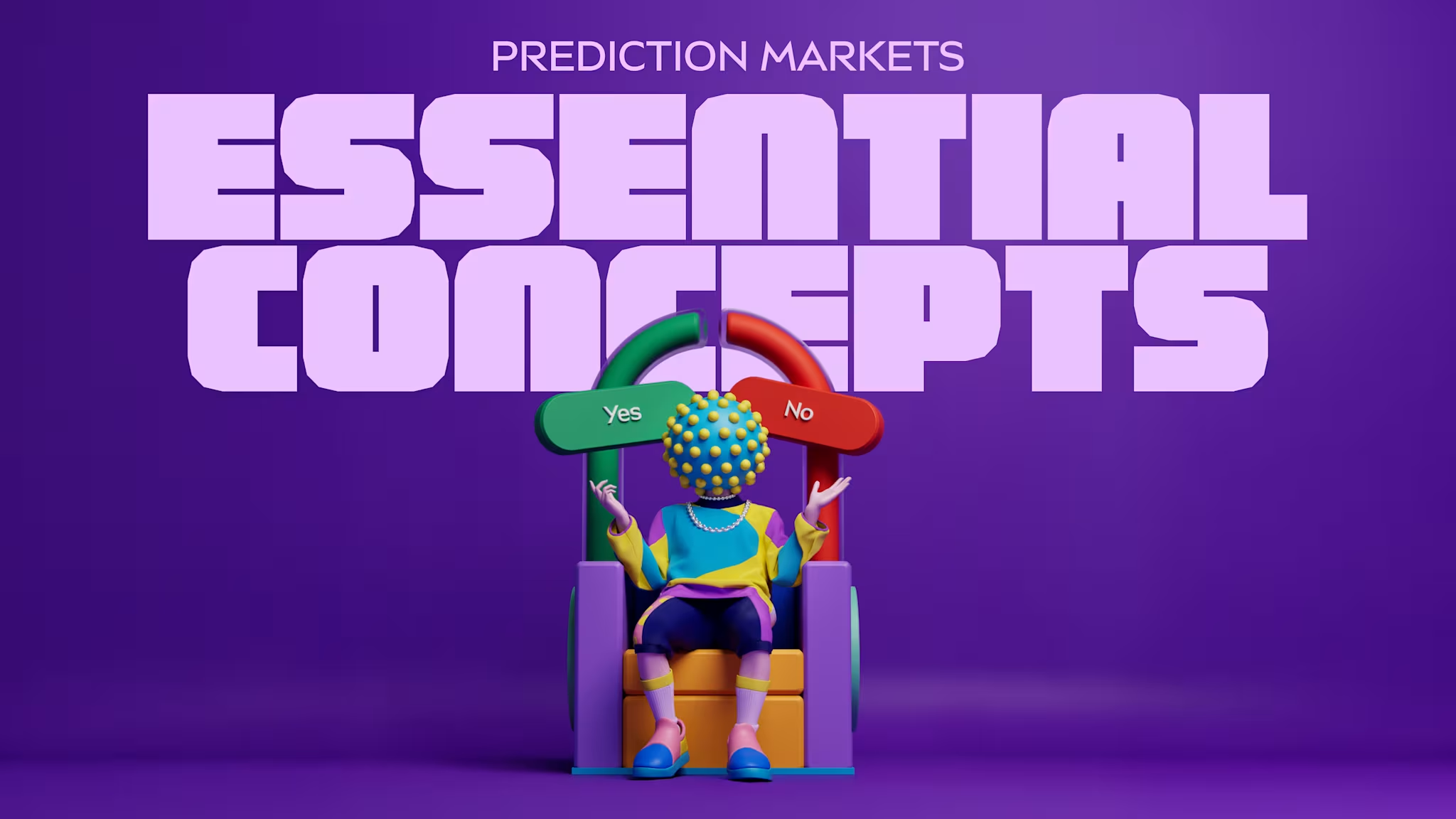
Prediction markets let people speculate on the future outcomes of real-world events. The price of a contract reflects what the crowd believes will happen. Instead of trading company shares, users trade on the likelihood of possible outcomes—usually YES/NO or multiple choice results for elections, sports, or economic data.
Decentralized prediction markets run on blockchain networks, so activity is transparent and peer-to-peer. Using self-custodial crypto wallets like MetaMask, participants can trade directly, without intermediaries or KYC. As news unfolds, prices update, turning these markets into real time forecasts that blend public sentiment and private insight.
This article breaks down core prediction market ideas: how these contracts work, how they differ from betting, and key terms. Disclaimer: This content is for general educational purposes only, is not financial advice or a solicitation, and is not for UK audiences. Prediction markets come with a high risk of loss and are not suitable for everyone.
What is a prediction market?
Prediction markets let participants buy and sell contracts tied to future events. Each contract’s price reflects the market’s collective estimate of probability.
For example, if a YES contract on the Lakers winning the 2027 NBA championship trades at $0.75, the market implies a 75% chance of victory. Because these markets aggregate thousands or hundreds of thousands of views, their signals can outperform polls or pundits.
Binary contracts settle at $1 if the event happens and $0 if it doesn’t, making prices easy to read as probabilities. With built in incentives for accuracy, prediction markets reduce some common forecasting biases.
Takeaway: Contract prices act as real time probability estimates that aggregate diverse information.
Prediction market crowdsourcing for information gathering
The wisdom of crowds suggests that collective judgment can outperform individual expertise. In prediction markets, experts, hobbyists, and data driven traders all express their views through buy and sell orders.
As trades occur, the market converts everyone’s inputs into a single, cohesive number that updates constantly. Studies show prediction markets can be less biased than traditional polls when participation is broad and incentives are clear.
Participant type | Edge contributed |
Domain experts | Deep subject matter knowledge and context |
Data quants | Model based signals and backtests |
News arbitrageurs | Fast reaction to breaking info |
General traders | Broad sentiment and risk management |
Takeaway: Prediction markets harness diverse insights, often outperforming traditional polls in their accuracy.
How prediction market trading works
You buy shares in future outcomes you think are likely. Since most binary contracts pay $1 if the event occurs (and $0 if not), the price directly represents probability. A contract at $0.63 implies a 63% chance of the outcome happening.
Traders can open or close positions before the event resolves, responding to changing information in real time.
Trade lifecycle:
Market opens with clear rules and resolution criteria.
Traders place buy or sell orders for YES/NO shares.
Prices move as information or liquidity changes.
The event outcome is verified, and the market resolves.
Winning shares settle at $1; losing shares at $0.
Takeaway: Prices move with collective belief, allowing participants to act on information before resolution. Learn about advanced prediction market strategies from one of the world's most successful traders.
Prediction markets vs betting markets
Prediction and betting markets both deal with outcomes, but differ in structure. Prediction markets are peer to peer, focusing on fair pricing for probabilities, while betting markets rely on bookmakers setting the odds.
Dimension | Prediction markets (peer to peer) | Betting markets (bookmaker/house) |
Focus | Event probability, price discovery | House sets odds for entertainment |
Counterpart | Other traders | The bookmaker |
Regulation | Often light or decentralized | Tightly regulated |
Pricing | Market driven, probability based | Fixed odds with margin |
Payout structure | Binary contracts ($1 or $0) | Odds based payouts |
User base | Forecasters, quants, researchers | Betters |
Takeaway: Prediction markets emphasize transparency and crowd driven pricing instead of house set odds.
Prediction markets glossary and key terms
Market: The venue for a specific event with defined outcomes.
Event contract: A binary or multi-outcome instrument that pays per resolution.
Liquidity: How easily trades occur without moving the price.
Spread: The difference between the best ask (lowest price sellers demand) and the bid (highest amount buyers offer). A smaller spread means higher liquidity and lower costs.
Settlement: The payout process after event resolution.
Resolution source: The oracle or data provider verifying results.
Slippage: The gap between expected and filled price.
Market maker: Keeps trading smooth by offering both bids and asks.
Limit order: Specifies the worst acceptable price.
Market order: Executes immediately at current prices.
Maker/taker fee: Fee model for providing or taking liquidity.
For a complete guide to order types—including stop loss, take profit, stop limit, trailing stop, and OCO orders—see crypto order types.
Understanding Polymarket
Polymarket is a decentralized prediction market built on blockchain, where anyone can trade real world outcomes transparently. It’s self-custodial, so you keep control of your funds through a wallet like MetaMask. All trades, rules, and settlements are public and onchain. With MetaMask Prediction Markets, you can trade on Polymarket using your mobile device.
Order books and market mechanics
An order book shows current buy and sell offers, listing prices, and order sizes. As orders match, prices evolve toward a shared probability. For binary contracts, the midpoint price represents the implied probability. Checking order depth and recent activity helps gauge liquidity and execution quality.
Takeaway: Knowing terms like liquidity, spreads, and order types is key to understanding market behavior.
Types of prediction markets
Prediction markets vary by architecture and topic. Centralized platforms often hold funds and select listed events, while decentralized ones let users self-custody assets and create markets freely.
Type | Characteristics | Categories |
Centralized finance (CeFi) platform | Custodied funds, curated listings, fiat onramps | Politics, sports |
Decentralized finance (DeFi) platform | Onchain settlement, self custody, transparent | Crypto, macro, entertainment |
Enterprise/internal | Private access, KPI forecasting | Timelines, sales forecasts |
Topic specific | Narrow focus for expertise | Elections, climate, policy |
Multi outcome | Bracket/tournament setups | Awards, multicandidate races |
Takeaway: Each market type serves different needs, from compliance‑focused venues to open, composable DeFi protocols.
Advantages and challenges of prediction markets
Prediction markets generate real time price signals and can be highly accurate when liquidity is strong. Transparent rules, clear incentives, and fast updates make them powerful forecasting tools.
Challenges include thin liquidity in niche areas, unclear regulation, and ethical concerns about sensitive topics.
Advantages | Challenges |
Democratized peer to peer forecasting | Thin liquidity in niche markets |
Rapid, info rich pricing | Regulatory uncertainty |
Transparent settlement | Ethical questions in event design |
Incentives for accuracy | Potential info asymmetry |
Takeaway: When well governed and liquid, prediction markets can be more accurate than traditional forecasting tools.
Prediction market risks
Prediction markets carry risks such as: low liquidity, uneven access to data, regulatory change, and potential manipulation. For instance, bad actors may buy aggressively to distort prices.
Decentralized designs, public auditability, and clear resolution criteria help limit these issues. Users should understand market mechanics, fees, and settlement rules before participating.
Takeaway: Transparency and vigilance protect against manipulation and structural risk.
Real world applications
Prediction markets forecast elections, economic indicators, sports events, and company performance. Businesses also use internal markets to predict project timelines or KPIs, surfacing honest forecasts from team members.
Public markets often produce more accurate, continuously updated probabilities than traditional polls. Realistic forecasting—on cost, timing, or outcomes—can also inform better policy and resource decisions.
Takeaway: Prediction markets turn collective intelligence into actionable insights across sectors.
Future trends in prediction markets
The next generation of prediction markets will likely integrate AI‑powered analysis, stronger oracles, and crosschain liquidity. Clearer regulations could invite institutional adoption and broaden participation.
Better user interfaces—especially mobile wallets, like MetaMask Prediction Markets—will make prediction trading more intuitive. As global uncertainty grows, the demand for transparent forecasting tools could rise.
Takeaway: AI, onchain oracles, and accessible UX are shaping the future of decentralized prediction markets.
Conclusion
Prediction markets bring together finance, crowd wisdom, and blockchain transparency to create real time forecasting tools. Understanding how prices reflect probabilities—and how liquidity, rules, and decentralization shape outcomes—helps users interact with these platforms more confidently.
As AI advances, oracles improve, and regulation matures, prediction markets are poised to become a trusted foundation for global forecasting and decision‑making.
- MetaMask

- DEVELOPERS
Agentic wallet security: how AI agents can transact with less risk
Agent wallets face prompt injection, key exposure, and permission risk. Here's how wallet isolation and spend limits minimize risk.
- GUIDES

What is Hyperliquid?
Hyperliquid handles ~$195 billion in 30-day perpetual futures volume across 350+ markets. built on a custom blockchain. Learn how Hyperliquid works, how to trade on it, and how it ranks versus competitors.
- GUIDES

How prediction market pricing works: from shares to resolution
Learn how prediction market shares reflect probability, how CLOB order books move prices, what happens at resolution, and when markets misprice.
