
MetaMask, formerly Consensys Software Inc, is the world's largest self-custodial financial platform, giving people a single place to hold, spend, save and grow their money across both crypto and traditional assets. The company is building the consumer platform where that happens, bringing payments, savings, investing and digital assets together in one seamless experience. Having grown from the world's most widely used self-custodial wallet, MetaMask gives users direct control over their money and assets, with reach across approximately 190 countries. MetaMask has played a foundational role in Ethereum's growth since 2016. Today, MetaMask sits at the center of the blockchain economy, building the operating system for Open Money and putting people in full control of their financial lives.
Read all articles
A crypto analytics tool is a platform that turns raw, real-time blockchain and market data—transactions, wallet activity, protocol flows, derivatives positioning, social sentiment, and holdings—into information a person can use when trading or investing. In 2026, the leading crypto market analytics dashboards fall into 7 categories: blockchain intelligence and wallet-labeling platforms like Nansen and Arkham, SQL dashboard tools like Dune, curated metrics and fundamentals products like Glassnode, Messari, and Token Terminal, DeFi data like DeFiLlama, derivatives dashboards like CoinGlass, sentiment tools like Santiment, price-charting and technical-analysis platforms like TradingView, and asset trackers like DeBank, Zerion, and CoinStats. Choosing the strongest setup is usually one broad anchor plus specialist layers added as a question narrows. Each type and its leaders are covered below.
Disclaimer: This guide is for educational purposes only. It is not financial advice, not a solicitation, and not for UK audiences. Crypto analytics tools can be incomplete or misleading.
What crypto analytics tools actually do
A blockchain analytics platform ingests blockchain data—blocks, transactions, logs, traces, state—and exposes it through a user-facing layer. That layer is usually one of 3 things: a SQL editor for custom queries (Dune, Allium, Flipside), a labeled dashboard that tags wallets by identity (Nansen, Arkham), or a curated metrics product that packages specific indicators (Glassnode, Token Terminal, DeFiLlama). Alongside those sit market-data and charting tools, derivatives dashboards, sentiment platforms, and asset trackers, each answering a different kind of question.
This is a different task from checking a price. A price tracker tells you what an asset costs. An analytics tool tells you what's happening beneath the price: who's moving funds, where liquidity is flowing, how a protocol earns, how the derivatives market is positioned, and how holdings have performed. For price-checking and market-data aggregation specifically, see the price-trackers guide and the /price/ pages.
Common types of crypto analytics tools
Most questions map cleanly to one category:
Onchain intelligence: wallet labels, smart-money tracking, and entity attribution.
Custom dashboards: SQL access to raw chain data for bespoke queries.
Fundamentals and metrics: packaged indicators on cycles, protocol revenue, and research.
DeFi data: TVL, yields, and protocol activity across chains.
Derivatives data: open interest, funding rates, and liquidations.
Sentiment and social: social volume and crowd positioning.
Asset tracking: the value and activity of assets a person actually holds.
Blockchain intelligence and wallet address labeling
Nansen specializes in wallet labeling and smart-money tracking. With 500M+ labeled addresses, it identifies exchanges, funds, market makers, and high-performing wallets, so a user can follow what experienced capital is doing in real time. Simplified pricing in 2026, with a Pro plan ~$49/month billed annually, made it more accessible than in prior years. Best for tracking specific entities and capital rotation.
Arkham focuses on entity-level wallet investigation, attributing addresses to real-world entities, and its Intel Exchange lets analysts buy and sell wallet intelligence. The core platform is free. Best for whale-watching and entity attribution.
Bubblemaps visualizes how tokens are distributed and how wallets connect, which is useful for spotting concentrated holdings or clusters of related addresses before they move. Best for token-distribution forensics.
Custom dashboards (SQL)
Dune Analytics is the SQL-first platform: anyone can query onchain data and build custom dashboards, and 200K+ community dashboards already exist to fork. It's a strong free starting point, but the most powerful use takes SQL fluency.
Flipside and Allium occupy the same space, Flipside with a community-and-bounty model, Allium aimed more at enterprise data pipelines. Best for custom, reproducible onchain research.
Fundamentals, metrics, and research
Glassnode delivers institutional-grade onchain metrics focused on market cycles (holder behavior, exchange flows, realized profit and loss, and network health), with a heavier focus on Bitcoin and Ethereum. Pricing ranges from free metrics to paid Studio tiers, with an Advanced plan ~$49/month and higher institutional tiers priced on request. Best for macro cycle analysis on major assets, less useful for altcoin or memecoin forensics.
Token Terminal frames protocols like companies, with fees, revenue, and financial-style metrics, the angle Glassnode and Dune don't prioritize. Best for fundamental, revenue-based protocol analysis.
Messari provides institutional-grade research: detailed reports, project profiles, tokenomics, governance updates, and market intel across thousands of assets, increasingly structured with AI. Much of the deepest research now sits behind Messari's Enterprise plan, which is custom-priced after it retired its older Lite and Pro tiers in 2026, so it's a serious-investor tool rather than a casual one. Best for long-horizon project due diligence.
CryptoQuant and Artemis round out this layer: CryptoQuant for exchange-flow and onchain trading signals often paired with charting, and Artemis for cross-ecosystem dashboards covering developer activity, DEX volumes, and chain comparisons, with free ecosystem reports. Best for trading confirmation (CryptoQuant) and ecosystem comparison (Artemis).
DeFi data
DeFiLlama is the DeFi data source, free to browse for total value locked (TVL) across every major chain, plus yields, fees, and protocol activity, giving a neutral view of where capital is flowing, and it covers more protocols than most paid alternatives. A paid Pro plan (~$49/month) adds AI-assisted research, custom dashboards, and data exports. Best for protocol and chain activity, yields, and TVL.
Derivatives data
CoinGlass specializes in the derivatives market (open interest, funding rates, and liquidation data), which is often what's actually driving a sharp price move. Best for reading leverage and positioning behind volatility.
Social media sentiment
Santiment tracks the human side of the market (social media volume, developer activity, and crowd sentiment) to flag when a project is overhyped or when fear is peaking.
LunarCrush offers similar social signals. Best for gauging crowd positioning as a contrarian or confirming signal.
Individual crypto asset trackers
Asset trackers follow the value and activity of assets a person actually holds, rather than the whole chain. A note for 2026: Zapper, long a default, shut down on August 3, 2026.
DeBank reads onchain DeFi positions in real detail across EVM chains, and its core tracker is free (an optional custom Web3 ID carries a one-time fee), though it skips centralized-exchange balances.
Zerion is the cleanest all-round wallet-plus-tracker for most users, with a free tier and premium features behind a $99 yearly pass.
CoinStats is the one tool here that unifies centralized-exchange and onchain holdings: connect exchanges by read-only API key and add wallet addresses to see one combined portfolio across 300+ venues, with a free tier covering 10 portfolios. Best picks: DeBank for EVM DeFi depth, Zerion for an all-round view, CoinStats for a unified CEX-plus-DeFi portfolio.
For a self-custody holder, the simplest starting point is within the MetaMask wallet itself: it shows the assets held across the networks it connects to and links straight into swapping or bridging them, so checking a balance and acting on it happen in the same place. It's a hold-and-act view rather than an onchain-forensics platform in the class of Nansen or Glassnode. For deeper research, the tools above go further.
How the top crypto analytics dashboards compare by type, use cases, skill, and cost
The table below compares the leading tools on what each does, who it is for, the skill it takes, and what it costs.
Tool | Type | Best for | Skill required | Cost (2026) |
Nansen | Onchain intelligence | Following entities and smart money | Low–medium | |
Arkham Intelligence | Entity attribution | Whale and entity investigation | Low–medium | |
Dune | SQL dashboards | Custom onchain research | Medium–high (SQL) | |
Glassnode | Cycle metrics | BTC/ETH macro analysis | Low–medium | |
Token Terminal | Fundamentals | Protocol fees and revenue | Low–medium | |
Messari | Research | Long-horizon due diligence | Low | |
DeFiLlama | DeFi data | TVL, yields, protocol activity | Low | |
CoinGlass | Derivatives | Open interest, funding, liquidations | Low–medium | |
Santiment | Sentiment | Social and crowd positioning | Low–medium | |
TradingView | Price data and charts | Technical analysis and indicators | Low–medium |
Sources: Pricing and features from each tool’s own pages: Nansen, Arkham, Dune, Glassnode, Token Terminal, Messari, DeFiLlama, CoinGlass, Santiment, and TradingView.
How crypto asset trackers compare by coverage and cost
Crypto data and real-time asset trackers DeBank goes deepest on onchain DeFi but skips centralized exchanges; CoinStats is the only one that folds in centralized-exchange balances alongside onchain holdings; and Zerion sits between them as the all-round option. All three are usable for free, with paid tiers, Zerion’s $99 yearly pass and CoinStats’ ~$14 a month, reserved for heavier use.
Sources: Coverage and pricing from DeBank, Zerion, and CoinStats
How self-custodial wallets compare for tracking crypto holdings
For a self-custody holder, the wallet itself is often the simplest place to see and act on holdings. Self-custodial wallets differ mainly in the networks they cover and how much of a portfolio view they build in.
Wallet | Networks | Portfolio and holdings view | Availability | Cost |
MetaMask | Multichain: Ethereum, Base, Arbitrum, Optimism, Polygon, BNB Chain, Avalanche, and Linea, plus non-EVM networks including Solana, Bitcoin,Polkadot, Starknet, Sui, and more | Multi-chain net worth, holdings, and DeFi positions; TradingView charts to 1-minute candles; watch up to 10 accounts plus hardware wallets | Mobile app, tablet app, web app, browser extension | Free |
Rabby | EVM chains | Portfolio view with a pre-signing balance-change preview | Mobile and browser extension | Free |
Phantom | Networks including Solana, Ethereum, Base, and Bitcoin | Multichain portfolio view | Mobile app and browser extension | Free |
Trust Wallet | Multiple blockchains including Bitcoin, Ethereum, and Solana | Basic multichain balance view | Mobile app and browser extension | Free |
Coinbase Wallet (Base app) | EVM chains, plus Solana and Bitcoin | Aggregated holdings view | Mobile app, web, browser extension | Free |
Rainbow | EVM chains | Positions view with watch-only wallets | Mobile app, browser extension | Free |
OKX Wallet | Multichain, including Solana and Bitcoin | Real-time balances and history across chains | Mobile app, browser extension | Free |
Sources: Network coverage and portfolio features from each wallet’s own documentation: MetaMask, Rabby, Phantom, Trust Wallet, Coinbase Wallet, Rainbow, and OKX Wallet.
Across these wallets, holdings tracking is free and multichain almost everywhere, and what differs is how much of a view each builds in, from a basic balance list to a full net-worth and DeFi breakdown. MetaMask provides the most comprehensive view, pairing net worth, holdings, and DeFi positions in one place with charts down to the 1-minute mark. It also includes a builtin Tax Hub that turns wallet and account history into jurisdiction-specific reports, with a free tier for estimates.
Which crypto analytics tools to use, by user type and needs
User type | Analytics needs | Commonly used analytics tools |
Everyday crypto holder | Track holdings and simple performance | CoinStats or Zerion; the MetaMask wallet |
Active trader | Time entries with charts, derivatives, and onchain signals | TradingView; CoinGlass; Glassnode or CryptoQuant |
Memecoin trader | Find new tokens, vet liquidity and holders, and ride hype | DEX Screener; Bubblemaps; Nansen or Arkham; Santiment or LunarCrush |
Long-term investor | Judge fundamentals and cycle position | Messari; Token Terminal; Glassnode |
DeFi participant | Track TVL, yields, and DeFi positions | DeFiLlama; DeBank |
DeFi researcher | Query data and trace wallet and entity flows | Dune; Nansen or Arkham; Bubblemaps |
Many traders end up using a small stack rather than one single tool or platform, matched to what they actually do onchain. An everyday holder can track balances and performance in a wallet like MetaMask or an app like CoinStats, while an active trader leans on charts and derivatives data from TradingView, CoinGlass, and Glassnode. Deeper work calls for specialists: DeFiLlama and DeBank for yields and positions, Dune and Nansen for querying data and tracing wallets, and Messari or Token Terminal for fundamentals. A commonly used approach is to pick one broad tool for day-to-day tracking and add more tools as specific needs come up.

- LATEST
Introducing MetaMask Transaction Shield
Get Transaction Protection and priority support for added peace of mind.
- LATEST
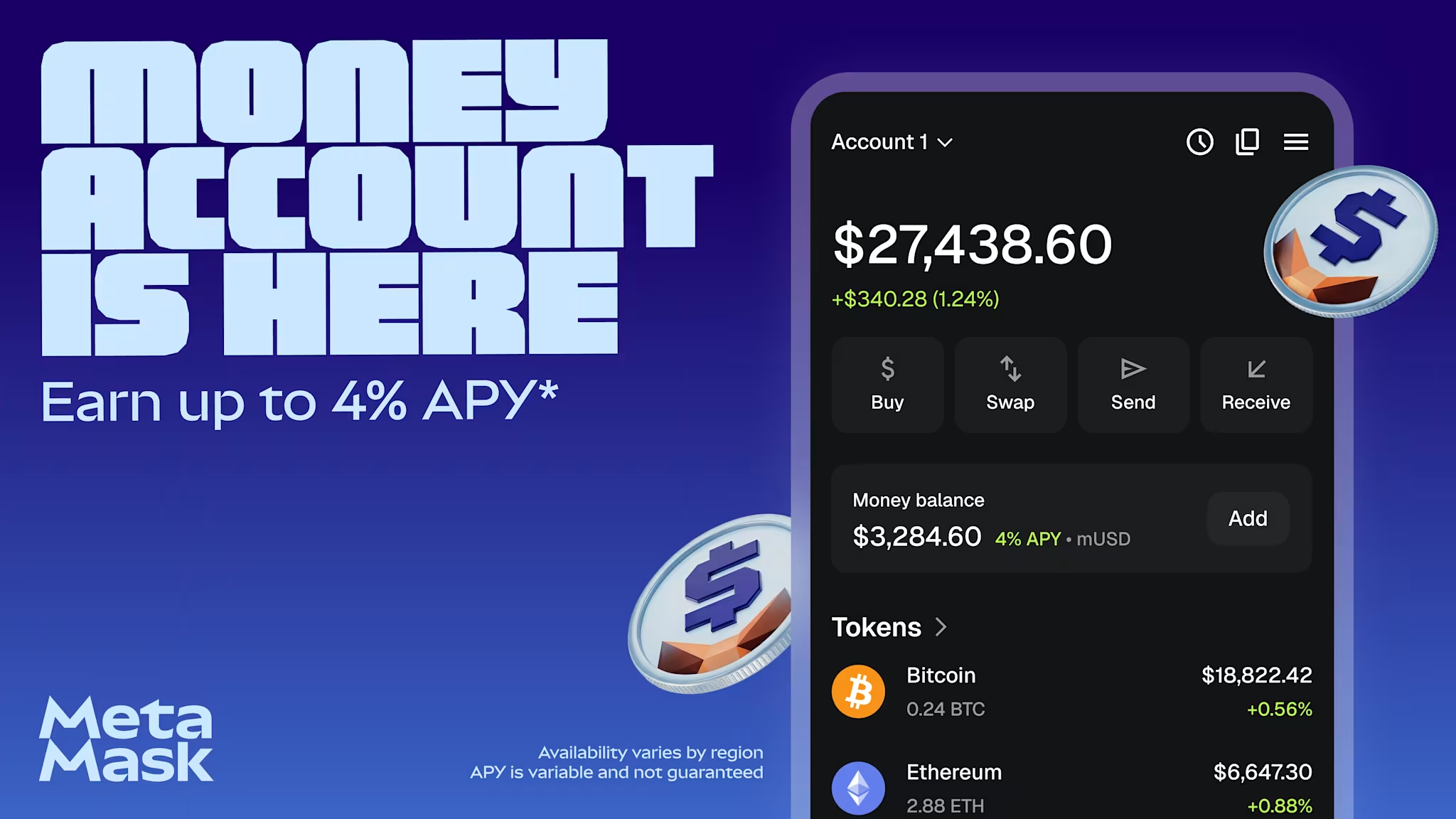
MetaMask launches Money Account, bringing DeFi yield and global spending to stablecoin balances
For the first time, users can earn up to 6% variable APY* on stablecoin balances and spend at hundreds of millions of merchants from a single self-custodial account, built on Monad.
- GUIDES

Top mobile crypto wallet apps in 2026
Compare the leading mobile crypto wallet apps across iOS and Android.
