
MetaMask, formerly Consensys Software Inc, is the world's largest self-custodial financial platform, giving people a single place to hold, spend, save and grow their money across both crypto and traditional assets. The company is building the consumer platform where that happens, bringing payments, savings, investing and digital assets together in one seamless experience. Having grown from the world's most widely used self-custodial wallet, MetaMask gives users direct control over their money and assets, with reach across approximately 190 countries. MetaMask has played a foundational role in Ethereum's growth since 2016. Today, MetaMask sits at the center of the onchain economy, building the operating system for Open Money and putting people in full control of their financial lives.
Read all articles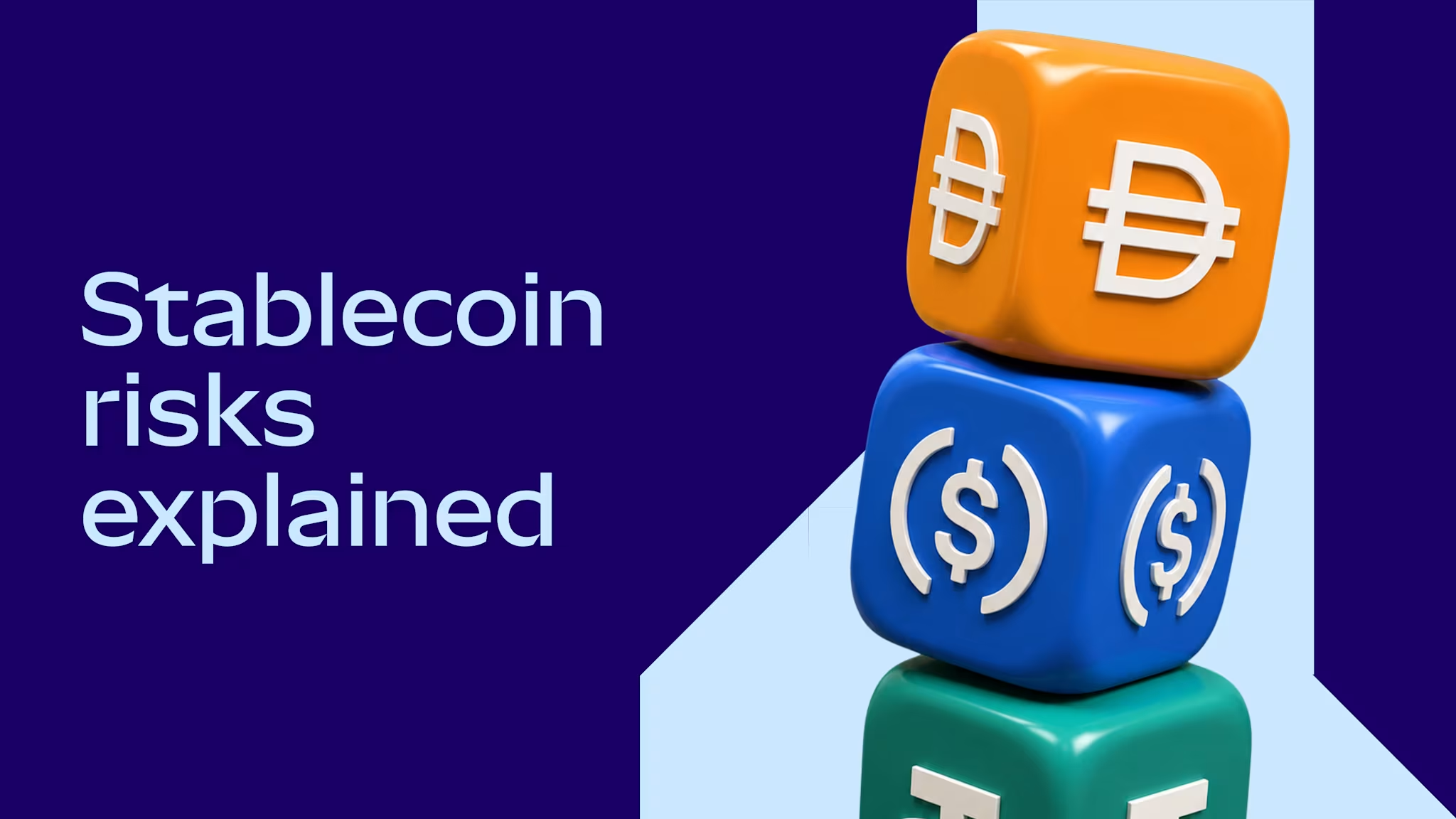
Stablecoins are a type of digital asset that have distinct risks based on their structure, backing, and regulations. A stablecoin is a cryptocurrency designed to hold a steady value, such as 1 US dollar or 1 Euro, by maintaining reserves of that underlying asset or running a mechanism that upholds its price. The value any stablecoin is designed to track is called its peg. A stablecoin can break that peg and trade below the target price even when it's described as fully backed, because the peg is held by a mechanism, not guaranteed by markets. The 5 main stablecoin risk categories are: depeg risk, reserve composition risk, smart contract risk, regulatory risk, and redemption risk.
Holders, the DeFi (decentralized finance) apps that use stablecoins as collateral or settlement, and the issuers who manage reserves and redemptions all carry some version of these risks, though not equally. A holder using a fiat-backed stablecoin for payments faces different exposure than a DeFi user who's supplied an algorithmic stablecoin as collateral in a lending protocol. Understanding which risks apply to which stablecoin model is key starting point for assessing any of them. Disclaimer: This guide is for educational purposes only. It is not financial advice, not a solicitation, and not for UK audiences. Stablecoins are risky and not suitable for all users.
Why stablecoin risks exist
A stablecoin's peg isn't enforced by any law of markets; it's maintained by a mechanism, and every mechanism has inherent risks. Fiat-backed stablecoins depend on an issuer actually holding redeemable reserves and honoring redemptions on demand. Crypto-collateralized stablecoins depend on collateral value staying above a liquidation threshold, the point at which collateral is automatically sold to cover the debt, even during sharp price swings. Algorithmic stablecoins depend on market incentives to expand or contract supply, which only works as long as participants believe the mechanism will hold, a belief that can unwind quickly once it's tested under stress.
How to assess a stablecoin's safety
No stablecoin is risk-free, but the assets with the strongest records share a set of checkable traits. The table below lists what to look at before relying on any stablecoin. Remember: these considerations are a guide, and not financial advice. Always do your own research, and assess your risk tolerance accordingly.
Factor | What to check |
Transparency | Regular, independent attestations or audits of reserves, from a named third party |
Reserve type | Cash and Treasuries vs commercial paper, corporate debt, or illiquid assets |
Issuer track record | Length of operation and behavior during past stress events |
Contracts and chains | Audited smart contracts, and which networks the token is natively issued on vs bridged |
Regulatory standing | Compliance with frameworks like the GENIUS Act (US) or MiCA (EU) |
Model | Fiat-backed, crypto-collateralized, or algorithmic |
Redemption access | Who can redeem directly with the issuer, and under what minimums |
Some holders may choose to diversify across more than one transparent, well-backed stablecoin rather than concentrating in a single issuer or model, since that approach limits exposure to any one reserve, redemption, or regulatory event, though diversification doesn't remove any of the risk categories above, it only spreads them. Purely algorithmic models have the weakest historical track record among the major categories, with Terra USD (UST) and Iron Finance's TITAN as 2 major examples of design-level failure rather than external shocks.
Stablecoin depegging risk
A depeg occurs when a stablecoin trades away from its target price, for example 1 USD or 1 Euro. Depegs can range from brief, cents-level dips that recover within hours to total, irreversible collapse. Usually this is determined by whether backing was genuinely liquid and sufficient, or whether the peg depended on market confidence and continuous demand.
TerraUSD (UST), May 2022. UST was an algorithmic stablecoin that maintained its peg through a mint-and-burn relationship with its sister token, LUNA, creating or destroying tokens to expand or contract supply, rather than through cash or asset reserves. In spring 2022, at its peak, UST's market capitalization exceeded $18 billion, much of it drawn by the Anchor Protocol's ~20% yield offer, according to Chainalysis's account of the collapse.
On May 7, 2022, large withdrawals from a UST liquidity pool, a shared pot of tokens that lets people trade one asset for another without a traditional order book, triggered a depeg below 1. Over the following days, Luna Foundation Guard deployed ~3 billion in bitcoin reserves to defend the peg, but the defense failed. By May 13, 2022, UST had fallen to ~0.10to~0.15 and LUNA's circulating supply had hyperinflated from ~350 million tokens to more than 6.5 trillion as the mint mechanism tried and failed to absorb the sell-off. The Federal Reserve's research on the episode traces the self-reinforcing "death spiral" and its spillover across decentralized finance; by the time it ended, tens of billions of dollars in combined UST and LUNA value had evaporated within a week. The Congressional Research Service later published a short explainer on the mechanics for lawmakers.
USDC, March 2023. USDC is a fiat-backed stablecoin issued by Circle. On March 10, 2023, Silicon Valley Bank was shut down by regulators after a bank run, and Circle disclosed that evening that 3.3billion of USDC’s~40 billion in reserves, ~8% of the total, remained stuck at the failed bank, as Circle confirmed. USDC fell to ~$0.87 in the early hours of March 11 and stayed below its $1 target through the weekend, according to a Federal Reserve analysis. The depeg spread to other stablecoins with exposure or correlated liquidity, including DAI, USDD, and USDP.
Resolution came after the US Treasury and federal regulators announced on March 12, 2023 that all Silicon Valley Bank depositors would be made whole, and Circle then confirmed that the $3.3 billion would be fully available and that USDC remained redeemable 1:1 with the dollar. USDC’s price recovered once Circle resumed processing redemptions on March 13, 2023. The episode still reshaped where Circle kept its cash: reserves held at US banks fell from $11.5 billion on March 6 to $3.7 billion by March 31 as Circle diversified its banking relationships, according to a Federal Reserve analysis of the episode.
Iron Finance (TITAN), June 2021. Iron Finance ran a two-token system on Polygon: the IRON stablecoin and TITAN, a volatile token used partly as collateral. On June 16, 2021, large holders began selling TITAN directly into liquidity pools rather than redeeming it in an orderly way, and the protocol's stabilization mechanism had no built-in incentive for arbitrageurs, traders who profit from price gaps, to step in once TITAN's price was falling fast.
TITAN dropped from ~$65 to effectively $0 within ~12 hours, an event Iron Finance itself later called crypto’s “first large-scale bank run” in its own postmortem. The Federal Reserve later analyzed the failure alongside similar algorithmic-stablecoin runs, concluding that the underlying design flaw, a no-arbitrage mechanism that only worked while prices were stable, wasn’t easily fixed by patching code.
USDR, October 2023. Real USD (USDR) was a Polygon-based stablecoin backed partly by tokenized real estate and partly by DAI held as a liquid buffer. When the DAI portion of reserves fell to around 27% of the total, a wave of redemptions exhausted the liquid DAI within hours, leaving only real estate tokens in the treasury, assets with claimed value but no way to convert them to cash quickly enough to meet redemptions.
USDR fell to ~$0.53 on October 11, 2023, with some data showing an intraday low near $0.50. Tangible, the issuer, confirmed that all of the liquid DAI had been redeemed, which it said triggered panic selling. The project ultimately wound USDR down rather than restore the peg, a case that illustrates a distinct lesson from UST and USDC: a stablecoin can be “fully backed” by total asset value on paper and still fail a run if a large enough share of that backing can’t be sold quickly.
These events span the broad structural categories of depeg: mechanism failures, where the design itself couldn't survive a stress test (UST, Iron Finance and TITAN), and reserve-liquidity failures, where the backing existed but wasn't accessible fast enough (USDC and SVB, USDR). Algorithmic and thinly collateralized designs have a much weaker record recovering from design failures. Fiat-backed coins with liquid, transparent reserves have typically recovered from reserve liquidity failures..
Stablecoin reserve composition risk
For asset-backed stablecoins, what actually holds the reserves determines how safe the peg is under stress. Reserves can range from cash and short-term US Treasuries, which are highly liquid and easy to value, to commercial paper (short-term corporate debt), corporate bonds, or other assets that are harder to sell quickly without a discount. A stablecoin backed mostly by cash and Treasuries with regular, named third-party attestations and clear reporting carries lower reserve risk than one backed by opaque, illiquid, or self-issued assets. For example, Circle's 2026 transparency reporting shows USDC's reserves held the large majority in short-dated US Treasuries through the Circle Reserve Fund, a registered government money market fund (a regulated fund that holds only short-term, low-risk assets) managed by BlackRock, and the remainder in cash at banks, verified through monthly third-party attestations, on Circle’s transparency page.
Tether’s Q1 2026 attestation, prepared by BDO, reported ~141 billionin direct and indirect US Treasury exposure against ~183 billion in total token-related liabilities, alongside smaller reserve components including ~$20 billion in gold and $7 billion in bitcoin and a reported $8.23 billion excess-reserve buffer, as of its Q1 2026 attestation. Its Q2 2026 attestation, reported a smaller ~$4.11 billion excess-reserve buffer and gold holdings above 146 tons. An attestation is not the same as a full audit. Tether completed its first full independent audit in August 2026, conducted by KPMG, which issued an unqualified opinion, distinct from its existing quarterly attestations.
Stablecoin smart contract risk
Every stablecoin, regardless of backing model, runs on smart contracts to manage minting, burning, and transfers. Bugs, exploits, or flaws in upgradeable contract logic can freeze funds, allow theft, or break the peg mechanism directly. Audits reduce this risk but don't remove it; audited contracts have still been exploited in DeFi more broadly.
Crypto-collateralized stablecoins tend to carry more smart contract surface area than fiat-backed ones, because their entire collateral and liquidation system operates onchain, directly on the blockchain, rather than through offchain custodial reserves. This is a structural tradeoff: fiat-backed models concentrate risk in the issuer and its banking relationships, while crypto collateralized models concentrate risk in contract code and oracle reliability, the price feeds that tell the contracts what collateral is worth.
Stablecoin redemption risk
Redemption risk is the question of whether a holder can actually get the unit it represents, such as 1 USD or 1 Euro, back in exchange for a stablecoin unit, and under what conditions. Redemption details cover who is permitted to redeem directly with the issuer, often only large, verified institutional partners rather than retail holders, and whether the issuer can honor redemption requests at scale during stress.
If a large share of holders try to redeem at once, even a stablecoin with genuinely sufficient backing can face short-term liquidity strain: assets may need to be sold or unwound faster than planned, pushing the secondary-market price below peg until the issuer processes redemptions and confidence returns. The USDC and SVB episode and the USDR collapse both illustrate this mechanic, though with very different outcomes: USDC's backing was liquid enough for the market to recover once the redemption backlog cleared, while USDR's underlying reserves weren't liquid enough at all.
Historical stablecoin depegging events
Stablecoin | Date | Cause | Outcome |
TITAN / IRON (Iron Finance) | June 16, 2021 | Algorithmic design flaw; no arbitrage incentive during a rapid sell-off | TITAN fell to near $0; protocol collapsed |
UST (TerraUSD) | May 7–13, 2022 | Algorithmic mint-and-burn mechanism failed under large withdrawals; LUNA hyperinflated | UST fell to roughly $0.10; LUNA effectively wiped out |
USDC | March 10–13, 2023 | 8% of reserves ($3.3B) held at failed Silicon Valley Bank | Fell to ~$0.87; fully recovered within days after regulatory backstop |
USDR (Real USD) | October 11, 2023 | Liquid DAI portion of mixed reserves exhausted by redemptions | Fell to roughly $0.53; project wound down |
Source: Iron Finance and TITAN, Iron Finance postmortem; UST, Chainalysis; USDC, Circle; USDR, Tangible.
Stablecoin regulatory considerations
Stablecoins operate in a legal environment that’s still being built out, and it differs sharply by jurisdiction. In the US, the Guiding and Establishing National Innovation for US Stablecoins Act, known as the GENIUS Act, became the first federal stablecoin framework on July 18, 2025, per the White House, after the House passed it 308–122 on July 17 and the Senate 68–30 on June 17. Codified as Public Law 119-27, it requires payment stablecoin issuers to hold 100% reserves in cash, short-dated Treasuries, and other low-risk liquid assets, publish monthly reserve composition disclosures, and, for larger issuers (those with more than $50 billion in outstanding issuance), undergo annual audits; it also bars issuers from paying yield directly to holders, under the statute text.
The European Union’s Markets in Crypto-Assets Regulation (MiCA) takes a different approach, requiring "e-money token" and "asset-referenced token" issuers to be licensed EU entities with their own reserve, custody, and redemption requirements. That means a stablecoin can be compliant and freely usable in one jurisdiction while facing restrictions or delisting in another as rules diverge. Regulatory clarity can build trust in a stablecoin by formalizing reserve and redemption standards, but it can equally force an issuer to change its model, restrict who can access a coin, or wind a product down if it can't meet the new bar.
What are the risks of centralized stablecoins?
Centralized, fiat-backed stablecoins also typically include freeze and blacklist functions written into their contracts, letting the issuer freeze tokens at specific addresses to comply with law enforcement or sanctions requirements—a capability that doesn't generally exist in the same way for algorithmic or fully decentralized designs.
What are the risks of holding stablecoins in a self-custodial wallet?
Holding a stablecoin in a self-custodial wallet does not remove issuer-side risk. Self-custody removes the risk of a third-party exchange or platform failing with a holder’s funds, but the coin’s peg still depends on the issuer’s reserves and redemption process, so it's essential to check an issuer’s attestation report. Stablecoins are not bank deposits: they are not FDIC insured or government guaranteed, even when fully reserved.
- MetaMask

- DEVELOPERS

Uniswap apps are live with MetaMask Connect on EVM and Solana
Uniswap moved to wagmi v3 and adopted @metamask/connect-evm and @metamask/connect-solana, adding MetaMask support across both ecosystems without leaving familiar provider interfaces.

User update
MetaMask is responding to an incident affecting infrastructure. We have identified no immediate threat to MetaMask wallets.
- DEVELOPERS
How to set up MetaMask Agent Wallet and make your first trade
Install the CLI, add skills to your agent, pick a sign-in method and safety mode, fund your wallet, and place a first trade. Here's the full path.
