
MetaMask, formerly Consensys Software Inc, is the world's largest self-custodial financial platform, giving people a single place to hold, spend, save and grow their money across both crypto and traditional assets. The company is building the consumer platform where that happens, bringing payments, savings, investing and digital assets together in one seamless experience. Having grown from the world's most widely used self-custodial wallet, MetaMask gives users direct control over their money and assets, with reach across approximately 190 countries. MetaMask has played a foundational role in Ethereum's growth since 2016. Today, MetaMask sits at the center of the blockchain economy, building the operating system for Open Money and putting people in full control of their financial lives.
Read all articles
Key takeaways about slippage
Slippage is the difference between expected execution price and actual execution price. Market orders incur slippage. Limit orders don't (if they fill).
Order book depth determines slippage for central limit order books. Thin books mean large orders get increasingly worse prices. Thick books mean minimal slippage.
Automated market makers (AMMs) like Uniswap use a formula, not order books. Larger trades cause more price impact because they move more tokens through the formula.
Market conditions matter: high volatility increases slippage, low liquidity increases slippage, and correlated markets can create cascading slippage across multiple trades.
Wallets like MetaMask show slippage before confirming swaps; lower slippage tolerance (1–2%) on limit swaps protects against unexpected price impact.
Suppose bitcoin is trading at $85,000 on the chart. A trader places a market order to buy. It fills at $85,200. The difference in these amounts, in this case $200, is slippage—the gap between the expected execution price and the actual execution price.
Slippage is invisible without looking for it, but it's constant. Over 100 trades, slippage may be the difference between profiting and breaking even. Over 1,000 trades, aggressive slippage may cost thousands of dollars. Understanding where it comes from and how to minimize it is how many traders preserve their edge instead of bleeding it to execution. Slippage mechanics are different on centralized exchanges versus decentralized exchanges, which use different mechanisms than order books. But the principle is the same: when a trade executes, it moves the market slightly against the trader. The size of that movement is slippage.
Disclaimer: This guide is for educational purposes only. It is not financial advice, not a solicitation, and not for UK audiences. Crypto trading and slippage management are risky and not suitable for all users.
How slippage works on order book exchanges
A centralized exchange like Binance or Kraken uses an order book. Buyers place bids (offers to buy at a price), sellers place asks (offers to sell at a price), and trades happen when a bid and ask match.
The order book depth problem
When a market buy order executes, it takes the best available sell orders (the asks). If there's 1 BTC available at $85,000 and the order is for 5 BTC, that first 1 BTC fills at $85,000. But 4 more are still needed. The next best available asks are at $85,050, $85,100, $85,150, and so on. The order fills across all these levels, and the effective entry price is higher than the first price displayed.
This happens because the order book has limited depth. On major trading pairs, the depth is deep—thousands of BTC available at prices close to the best price. On obscure altcoins, the depth is thin—maybe only 10 coins available at prices within 1% of the best price. A large market order on a thin order book gets much worse prices. For how order type selection—market vs limit—affects this outcome, see crypto order types.
Calculating expected slippage on order books
Slippage can be estimated by looking at the order book. In a hypothetical scenario where a trader wants to buy 10 BTC and the order book shows:
2 BTC at $85,000
2 BTC at $85,050
3 BTC at $85,100
3 BTC at $85,200
A market order would take all of these for an average price of $85,100 (($85,000 × 2 + $85,050 × 2 + $85,100 × 3 + $85,200 × 3) ÷ 10). The expected price was $85,000; the actual fill was $85,100. That's $100 in slippage per BTC, or roughly 0.12%. On a 10 BTC position, that's $1,000 in absolute slippage. If a typical profit target is 2% on an $850,000 position ($17,000), slippage consumed about 5.9% of the expected profit.
Market conditions and slippage volatility
During calm markets, order book depth is consistent and slippage is predictable. During volatile events—major news, liquidation cascades, exchange outages—order book depth often collapses. The best asks pull back or disappear, and slippage skyrockets.
A market buy during calm hours on a major pair might incur 0.05% slippage. The same order during a flash crash or leveraged liquidation cascade could incur 2–5% slippage because the order book is sparse and participants are trying to exit simultaneously.
How slippage works on automated market makers (AMMs)
Decentralized exchanges like Uniswap use a different mechanism: automated market makers (AMMs). Instead of order books, they use a mathematical formula to determine price.
The constant product formula
The core formula is: x × y = k, where x is the quantity of token A in a liquidity pool, y is the quantity of token B, and k is a constant.
Consider a pool with 1,000 ETH and 400,000 USDC. The constant k = 1,000 × 400,000 = 400,000,000. The current spot price is 1 ETH = 400 USDC (the ratio of the pools).
A trader who wants to buy 1 ETH at the spot price would expect to pay 400 USDC. But the constant product formula adjusts the price as tokens move. To remove 1 ETH (leaving 999 ETH in the pool), the formula requires: 999 × y = 400,000,000, so y = 400,400.40 USDC. The trader must add 400.40 USDC to the pool—paying $400.40 per ETH instead of the $400 spot price. That $0.40 difference (roughly 0.1%) is slippage caused by price impact.
Now scale the trade up. To buy 10 ETH (leaving 990 ETH), the formula requires: 990 × y = 400,000,000, so y = 404,040.40 USDC. The trader adds 4,040.40 USDC for 10 ETH—an effective price of $404.04 per ETH. Slippage jumps to roughly 1%, ten times worse than the 1 ETH trade.
The key insight: on an AMM, slippage increases dramatically with trade size relative to pool liquidity. A 1 ETH trade on a 1,000 ETH pool is 0.1% of the pool and barely moves the price. A 10 ETH trade is 1% of the pool and incurs noticeably worse slippage. A 100 ETH trade would be far more expensive still.
Price impact on AMMs
AMM platforms often describe this as "price impact" instead of slippage. A trade's price impact depends on:
Pool liquidity: Deeper pools (more tokens) mean less impact per trade.
Trade size: Larger trades relative to pool size cause more impact.
Fee tiers: Uniswap v3 offers four standard fee tiers: 0.01%, 0.05%, 0.3%, and 1%. Deeper liquidity typically concentrates on lower-fee tiers, so a 0.01% pool may have less price impact than a 1% pool even though the higher fee encourages more capital.
Uniswap v4 launched in 2025, introduced dynamic fee hooks that allow pools to set custom fee structures beyond these fixed tiers.
On Uniswap, the interface typically displays expected slippage before confirming a swap. A 1,000 USDC swap to ETH might show 0.1% slippage. A 100,000 USDC swap might show 2–3% slippage because it moves a larger percentage of the pool.
Comparing slippage across venues and assets
Slippage varies significantly depending on where and what a trader is trading. The approximate ranges below reflect general market conditions and will vary based on order size, time of day, and liquidity at the time of execution.
Asset and venue | Approximate slippage range |
Bitcoin on a major centralized exchange | 0.02–0.05% |
Ethereum on Uniswap (0.3% pool) | 0.1–0.3% |
Major altcoin on a centralized exchange | 0.05–0.2% |
Emerging token on a centralized exchange | 0.5–2% |
Emerging token on Uniswap | 1–5% |
Extremely low-liquidity token on a DEX | 5–20%+ |
The pattern is clear: major assets on centralized exchanges have the least slippage. Obscure assets on decentralized exchanges have the most. This is why traders use different venues for different asset sizes. A large bitcoin trade goes to a centralized exchange. A small emerging token trade might go to a DEX but with much smaller position size to manage slippage.
Market orders vs limit orders: the slippage trade-off
Market orders incur slippage because they fill against resting orders in the book at progressively worse levels. Limit orders eliminate slippage on fills—but if the market never reaches the specified price, the order stays unfilled and the opportunity passes. The choice between speed and price control is central to order selection. For a complete breakdown of market, limit, stop loss, take profit, stop limit, and OCO orders—including when each makes sense and what each costs—see crypto order types: market, limit, stop loss, and take profit.
Minimizing slippage: practical strategies
Split large orders. Instead of buying 10 BTC in one market order, splitting into five orders of 2 BTC over a few minutes allows the order book to replenish between fills, resulting in better prices for each.
Trade during high-liquidity hours. Major exchanges have the deepest order books during peak trading hours (roughly 9 am–5 pm UTC on weekdays). Trading off-peak means thinner books and more slippage. Where flexibility exists, executing during peak hours can reduce costs.
Use slippage tolerance on AMMs. On Uniswap and similar platforms, slippage tolerance can be set to 1–2%. If slippage would exceed this threshold, the swap fails rather than executing at an unfavorable price. This also means orders won't fill in highly volatile conditions, but a failed swap is better than excessive price impact. MetaMask Swaps displays expected slippage, exchange rate, and price impact before confirming any trade, and slippage tolerance is adjustable (1% or lower is tight, 3% is loose) to control maximum acceptable impact.
Check liquidity before trading. On Uniswap, pool statistics are publicly visible. A token with $500,000 in liquidity will have much worse price impact than one with $50 million. Factoring this into position sizing helps manage slippage costs.
Avoid trading during volatility spikes. When markets are spiking—news events, liquidation cascades, technical breaks—slippage explodes. Order books collapse, AMM pools experience massive trades, and execution prices become unpredictable. Waiting for volatility to settle, where possible, reduces execution cost.
Use DEX aggregators. Services like 1inch or MetaMask Swaps automatically route orders across multiple DEXs to find the best execution price. Instead of swapping on just Uniswap, they might split an order across Uniswap, Curve, and Balancer to minimize price impact. For how limit orders, stop losses, and other order types work across perpetual futures and other trading venues, see crypto order types. The preview functionality shows the outcome before signing the transaction, confirming actual execution price against expected.
Calculating slippage impact on trading performance
Consider a hypothetical scenario: 100 trades per month, average position size of $20,000, and average slippage across all trades of 0.3% (a plausible range for someone mixing major assets on centralized exchanges with some lesser-known assets on DEXs).
Total slippage cost: 100 trades × $20,000 × 0.003 = $6,000 per month
If the trading edge expects 1% profit per trade, that's $20,000 total profit. Slippage consumes 30% of that edge. This is why institutional traders obsess over execution quality. A 0.05% improvement in average slippage saves $1,000/month in this example.
For most retail traders, slippage is the second-biggest cost after network fees (on decentralized exchanges). It can't be eliminated, but it can be minimized significantly through better order execution.

- LATEST
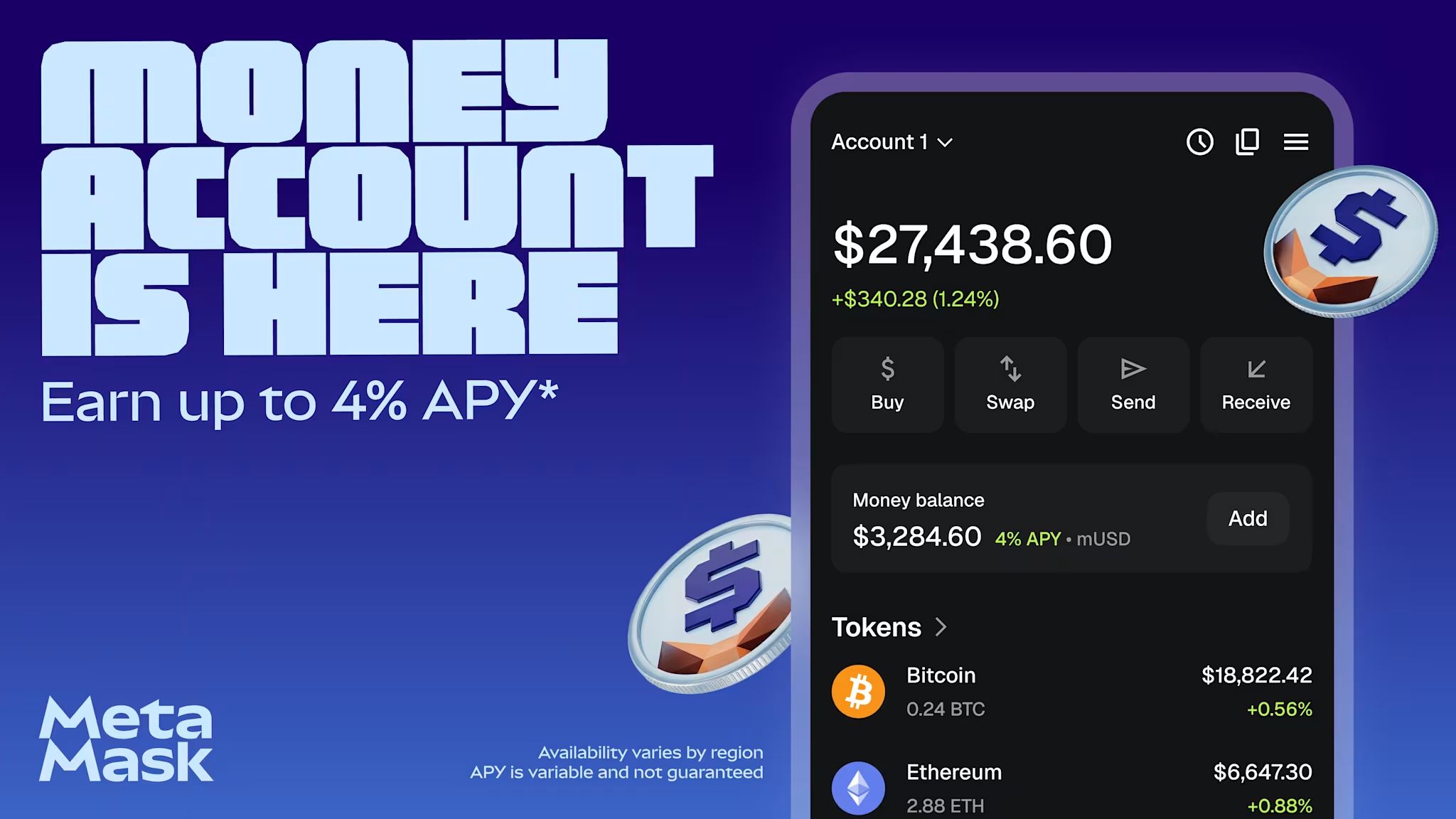
MetaMask launches Money Account, bringing DeFi yield and global spending to stablecoin balances
For the first time, users can earn up to 6% variable APY* on stablecoin balances and spend at hundreds of millions of merchants from a single self-custodial account, built on Monad.
- GUIDES

Top mobile crypto wallet apps in 2026
Compare the leading mobile crypto wallet apps across iOS and Android.
- GUIDES
Stablecoin vs bank account
Stablecoins and bank accounts both hold fiat value, but they operate on different infrastructure. This guide breaks down how protection, yield, transfer speed, and access differ.

