
MetaMask is the world's leading self-custodial crypto wallet and gateway to decentralized finance, built by Consensys.
Read all articles
A perps DEX is a decentralized exchange where traders open leveraged long or short positions on perpetual futures—contracts that track an asset's price with no expiry date—without a central intermediary holding custody of their funds. The top perps DEXs in 2026 by trading volume are Hyperliquid, Aster, Lighter, Grvt, and ApeX Protocol, each running its own order-book design, settlement chain, and fee schedule. "Leveraged" means the position is sized beyond the cash a trader puts up. This article ranks the top perps DEXs, explains how each is built, and compares them across fees, blockchain networks, and structure. For an intro to perps, see a guide to perps for beginners.
Disclaimer: The following content is for educational purposes only. It is not financial advice, not a solicitation, and not for UK audiences. Perpetual futures are risky and not suitable for all users.
What "perps decentralized exchange" means
A perps decentralized exchange (DEX) is a platform where perpetual futures contracts—derivatives with no expiry date that track an underlying asset's price—are traded, without a centralized exchange taking custody of user funds. Settlement, matching, or both happen on popular blockchain networks or on a purpose-built blockchain. Traders generally connect a self-custodial wallet rather than depositing funds into a centralized or broker-controlled account. There are 2 major perps DEX models.
Order-book model. Buy and sell orders are matched directly against each other, similar to a traditional exchange order book. All five of the highest-volume venues in 2026—Hyperliquid, Aster, Lighter, Grvt, and ApeX Protocol—run variations of this model.
Pooled-liquidity model. Traders take positions against a shared pool of liquidity provider (LP) funds, meaning capital supplied by others to earn fees, rather than against another trader's order. GMX and Gains Network use this model, sometimes called peer-to-pool, but both have slipped well down the volume rankings as order-book designs have taken over the top of the market.
Neither model is inherently safer or cheaper; each shifts risk and cost differently between traders, liquidity providers, and the protocol itself, as the venue-by-venue profiles below show.
How the top perps DEXs in 2026 were ranked
The 5 perps DEXs in this guide are ranked by 30-day trading volume from DefiLlama, since volume, and the liquidity behind it, most directly affect fill quality and slippage, and each is then compared across the same factors. The first is volume and liquidity, drawn from DefiLlama where settlement is fully onchain and independently verifiable, and treated with more caution where a platform self-reports its numbers. The second is each DEX’s fee schedule, the taker and maker rates a trader actually pays. The third is the settlement network; a platform running its own blockchain or appchain carries different risks than one built on shared smart contracts. The fourth is the design model, which shapes pricing, fill certainty, and who bears the risk.
How the top perps DEXs compare on volume, fees, chains, and design
The below table is a point-in-time snapshot. Volume and fee figures move daily, so each protocol's own dashboard is the place to check current numbers.
Exchange | Model | Settlement chain | Volume (approx., as of July 2026) | Taker fee (base tier) | Max leverage |
Hyperliquid | Central limit order book, onchain | Hyperliquid L1 (own chain) | ~$196.3B over 30 days; ~$3.9T cumulative | Scales with 14-day volume and HYPE staking tier; no fixed public flat rate | Up to 50x on major pairs |
Aster | Hybrid order book, no-bridge deposits | BNB Chain plus multichain deposits | As low as ~0.035% (pro mode) | Up to 1001x on select major pairs | |
Lighter | Central limit order book, zk-verified | Own zero-knowledge rollup on Ethereum | 0% for retail (market makers pay a small premium) | Up to 50x | |
Grvt | Hybrid order book, self-custodial | Own zkSync-based layer-2 | ~0.045% (~0.0001% maker) | Up to 50x | |
ApeX Protocol | Order book, omnichain | Multichain (Ethereum, BNB Chain, Solana via zkLink) | ~0.05% (~0.02% maker) | Up to 100x |
Source: 30-day volume and open-interest figures for all five venues from DefiLlama, as of July 30, 2026; fee and leverage details from each protocol's documentation and reputable reviews cited in the profiles below. Aster's headline volume is partly self-reported and warrants more caution than fully onchain venues.
Hyperliquid
Hyperliquid runs its own layer-1 blockchain built specifically for order-book trading, processing orders, cancellations, trades, and liquidations directly onchain rather than matching them off-chain and only recording the final result, as the guide to Hyperliquid explains. It has captured the largest share of decentralized perp volume of any single venue: DefiLlama's rankings put its share at roughly a third of all tracked perp volume, with 30-day volume around ~$196.3 billion and cumulative volume near ~$3.9 trillion as of July 30, 2026. Open interest, the total value of positions currently open, sits near ~$10.5 billion, supported in part by HIP-3, a framework that lets third parties launch new perp markets on Hyperliquid's infrastructure.
Traders deposit USDC, connect a self-custodial wallet, and trade at up to 50x leverage across 350-plus pairs as of July 30 2026, per CoinGecko. Users keep control of their own funds rather than transferring custody to an exchange or broker. Hyperliquid also powers MetaMask Perps, allowing traders to open perpetual positions directly from a MetaMask wallet without setting up a separate exchange account.
Aster
Aster combines order-book matching with a no-bridge deposit flow, letting traders fund accounts across multiple chains without a separate bridging step first. As of July 30, 2026 it ranked second among decentralized perps venues by 30-day volume, at ~$41.7 billion with open interest around ~$1.93 billion, per DefiLlama. Its taker fees run as low as about 0.035% in pro mode, and it advertises leverage up to 1001x on select major pairs with lower caps elsewhere, according to Coin Bureau.
Lighter
Lighter runs a central limit order book on its own application-specific zero-knowledge rollup on Ethereum, where every trade match, margin check, and liquidation is verified by a zk-SNARK proof, per DefiLlama. That verifiable-matching design is its main draw, paired with a retail-first fee model: standard retail accounts pay zero maker and zero taker fees, while market makers pay a small premium. As of July 30, 2026 it held third place among decentralized perps venues at ~$35.7 billion in 30-day volume, with open interest near ~$881 million, and it offers leverage up to 50x. Because settlement is fully onchain and proof-verified, its reported figures are independently checkable rather than self-reported.
Grvt
Grvt (pronounced "gravity") is a hybrid perps exchange that pairs a central limit order book with self-custodial settlement on its own zkSync-based layer-2 chain, aiming for a centralized-exchange trading experience without asking traders to give up custody of their funds. It carried roughly ~$34.9 billion in 30-day volume with open interest around ~$354 million as of July 30, 2026, per DefiLlama. Its fees sit among the lowest in the category, with maker fees near 0.0001% and taker fees around 0.045%, and it offers leverage up to 50x. Grvt has also expanded beyond perps into yield and wealth-management products, positioning itself as a more institutional, compliance-forward venue than most of its peers.
ApeX Protocol
ApeX Protocol, through its ApeX Omni product, runs an order-book perps exchange with an omnichain account model, letting traders fund and trade across Ethereum, BNB Chain, and Solana through zkLink infrastructure without manually moving assets between chains. It recorded roughly ~$33.0 billion in 30-day volume with open interest near ~$118.5 million as of July 30, 2026, per DefiLlama. Trading carries no gas fee for the user; taker fees run around 0.05% with maker fees near 0.02%, and leverage goes up to 100x. Its cross-chain funding and higher leverage cap are its main differentiators among the order-book leaders.
Other perps DEXs of note
Beyond the five highest-volume venues, a few other perps DEXs are worth knowing. dYdX pioneered the onchain order book and now runs on its own Cosmos SDK appchain, the dYdX Chain, where a validator network operates the order book and settles trades. GMX uses an isolated-pool architecture: in its v2 design each market is backed by its own dedicated liquidity pool rather than one shared vault, containing risk to a single market.
On Solana, Jupiter runs a popular pooled-liquidity perps product where trades are taken against the Jupiter Liquidity Provider (JLP) pool. These venues sit below the order-book leaders in volume, but GMX and Jupiter show the pooled-liquidity model still has real traction.
How order-book and pooled-liquidity designs differ
All five of the highest-volume decentralized perps venues in 2026—Hyperliquid, Aster, Lighter, Grvt, and ApeX Protocol—run order-book designs, matching trades directly between buyers and sellers. That tends to produce tighter spreads for actively traded pairs but depends on there being enough independent traders and market makers to fill orders. The alternative architecture, pooled liquidity, routes every trade against a shared LP vault, as on GMX and Gains Network, which guarantees a counterparty for any trade size but ties LP returns directly to trader losses and the reverse. Pooled-liquidity venues led an earlier phase of the market but now sit well below the order-book leaders in volume.
Funding rates, liquidation mechanics, and margin calculations work broadly the same way across both models: a small periodic payment between long and short positions, called the funding rate, keeps a perpetual contract's price aligned with the underlying spot price, and positions are automatically closed, or liquidated, if collateral falls below a maintenance threshold. For a full breakdown, see the explainers on perpetual futures liquidation and key perpetual futures concepts.
What actually determines trading cost on a perps DEX
The headline taker fee is only part of what a perp position costs. Three other charges often matter more over time: the funding rate, which can run for or against a position depending on which side of the market is crowded; price impact, the amount a large order moves the price against itself in a thinner market; and, on pooled-liquidity venues, a borrow or utilization fee that scales with how much of the pool a position draws on. A low advertised taker fee on a venue with thin liquidity or persistent adverse funding can cost more over a held position than a higher fee on a deeper venue. Comparing venues on the taker rate alone misses most of the real cost, which is why liquidity depth and funding history matter alongside the published fee.
How to choose which perps DEX to use
No single perps platform is best on every axis, so traders should choose a DEX based on their priorities and needs. The pairings below follow from the profiles above rather than from any ranking of one platform over another.
Priority | Platform(s) | Why it fits |
Deepest liquidity, tightest pricing on major pairs | Hyperliquid | Leads all decentralized perps by volume by a wide margin (~$196.3B / 30 days) |
Lowest trading costs | Lighter, Grvt | Lighter charges retail traders zero maker and taker fees; Grvt pairs near-zero maker fees with self-custodial, CEX-style settlement |
Widest cross-chain access | Aster, ApeX Protocol | Both let traders fund from multiple chains without manual bridging, with high leverage caps (up to 1001x on Aster, 100x on ApeX) |
Guaranteed counterparty regardless of order-book depth | GMX, Gains Network | Pooled-liquidity venues guarantee a counterparty for any trade size, though they sit well below the order-book leaders in volume |
Sources: 30-day volume rankings from DefiLlama; fee and leverage details from Lighter Docs, CoinGape, and Coin Bureau, as of July 30, 2026.
Security considerations
Security on a perps exchange spans more than smart contract audits. Order-book platforms that run their own chain or rollup, like Hyperliquid, Lighter, and Grvt, concentrate risk in that chain's validator set, proof system, and consensus mechanism rather than in a shared smart contract surface. Pooled-liquidity platforms concentrate risk in the shared vault's smart contracts and in the balance between LP deposits and open trader positions, since a large imbalance can leave a pool undercollateralized in extreme market moves.
Hyperliquid, the largest of these venues, illustrates both the strengths and the tradeoffs of running a purpose-built chain. Processing orders, margining, and liquidations fully onchain gives it deep, transparent execution, but it also concentrates security in the chain's own validator set and consensus rather than a shared smart-contract layer, and USDC deposits arrive through an Arbitrum bridge contract that adds a surface worth reviewing. Its long operating history and repeated audits count in its favor, though no own-chain venue is entirely risk-free. For traders who want that execution depth without giving up custody, MetaMask Perps routes orders to Hyperliquid while keeping funds in the trader's own wallet.
Newer platforms with less onchain history, self-reported volume, or smaller validator and auditor sets carry different risk profiles than protocols with years of continuous uptime and multiple independent audits, so reviewing a platform's audit history, time in production, and incident record is a standard part of assessing any of these venues rather than relying on volume rankings alone.
Perps regulations and regional availability
Availability, leverage limits, and required verification vary by platform and by the trader's jurisdiction, and eligibility should be confirmed directly with each protocol before use. Hyperliquid, for instance, restricts users in the United States, Ontario (Canada), and sanctioned jurisdictions such as Iran, North Korea, Syria, and Cuba under its terms of use, while remaining accessible to traders in many other markets, including Singapore, Hong Kong, South Korea, France, and Australia.
Perpetual futures trading is restricted or unavailable in a number of jurisdictions. Decentralized perps platforms, including those referenced in this article, are not available in sanctioned countries, and some face specific retail restrictions. For example, UK's Financial Conduct Authority banned the sale of crypto derivatives to retail consumers in 2021, and the EU's MiCA framework doesn't clearly cover leveraged derivatives like perps, leaving them under the older MiFID II regime in a legal grey area, as the beginners' guide to perpetual futures notes.
- MetaMask

- GUIDES
Bitcoin vs Ethereum: what's the difference?
Bitcoin and Ethereum are the two largest crypto blockchain networks, but they were built for different purposes. Explore how they compare.
- DEVELOPERS
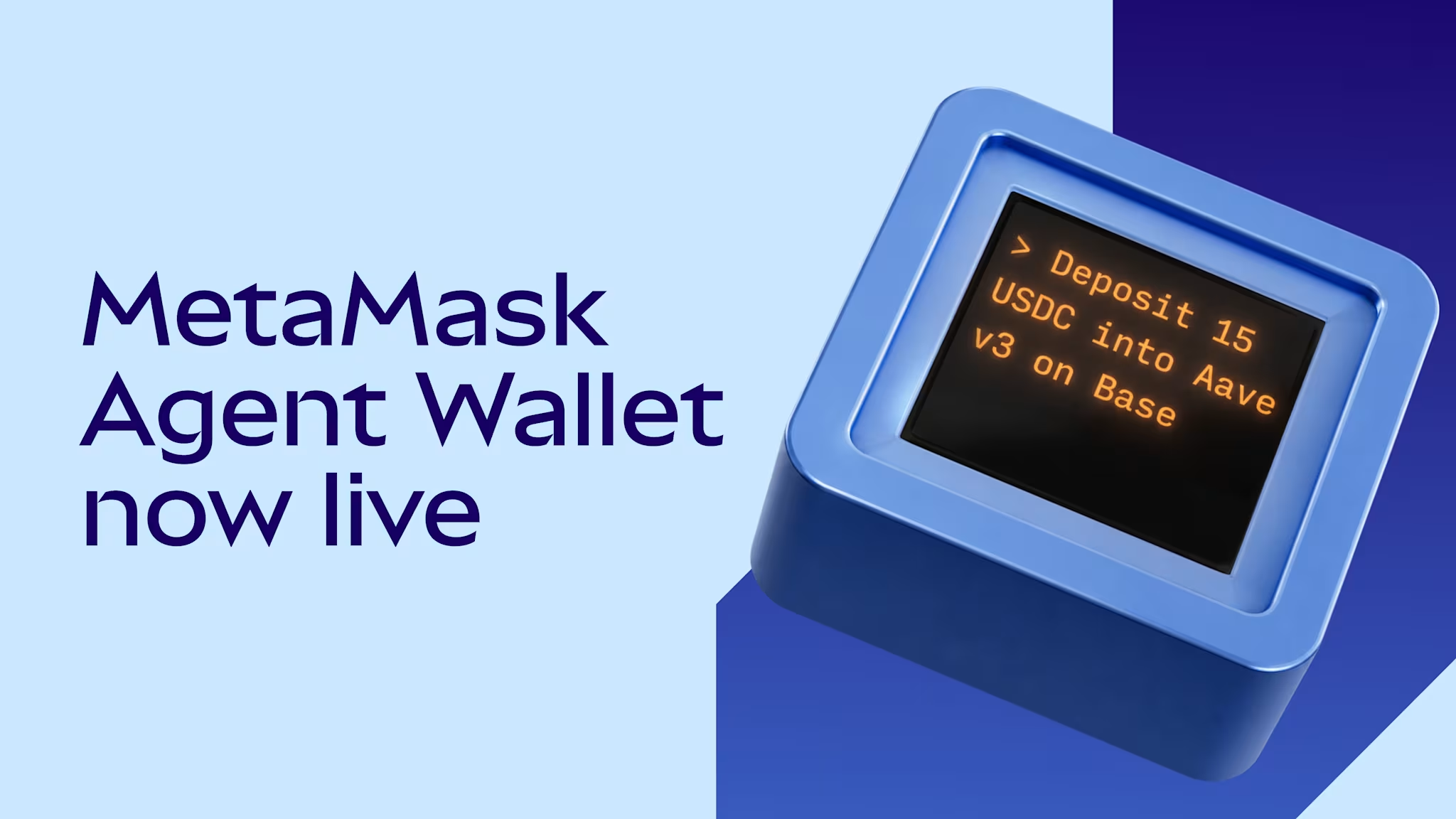
MetaMask Agent Wallet is now live
Set spend limits, allowlist protocols, and pick Guard Mode or Beast Mode, then let your agent execute behind threat scanning and MEV protection. No native gas token needed.
- GUIDES

Prediction markets in 2026: Key trends reshaping forecasting, trading, and regulation
Explore major prediction market trends in 2026 including Polymarket's CFTC approval, AI trading, sports contracts, evolving global regulations, and more.
