
MetaMask, formerly Consensys Software Inc, is the world's largest self-custodial financial platform, giving people a single place to hold, spend, save and grow their money across both crypto and traditional assets. The company is building the consumer platform where that happens, bringing payments, savings, investing and digital assets together in one seamless experience. Having grown from the world's most widely used self-custodial wallet, MetaMask gives users direct control over their money and assets, with reach across approximately 190 countries. MetaMask has played a foundational role in Ethereum's growth since 2016. Today, MetaMask sits at the center of the onchain economy, building the operating system for Open Money and putting people in full control of their financial lives.
Read all articles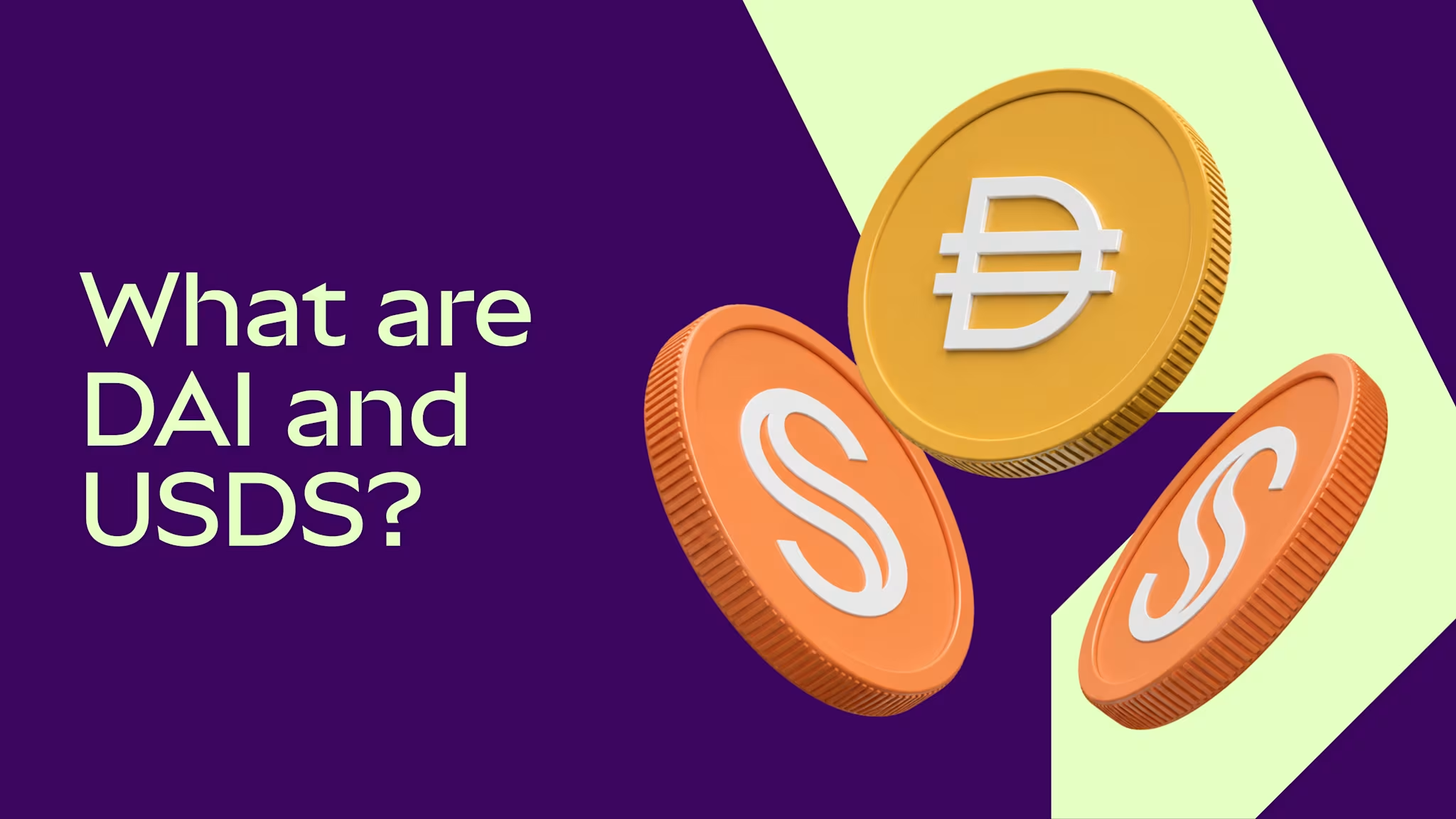
DAI is a decentralized, US dollar-pegged stablecoin backed by overcollateralized crypto assets locked in smart contracts on public blockchain networks, rather than by cash reserves held at a bank. USDS is DAI's successor token, both issued by Sky (the protocol formerly known as MakerDAO). DAI and USDS run on the same underlying collateral system, aim to maintain a steady value of $1, and are governed by holders of Sky's SKY token (formerly MKR) rather than by a single company. This article explains how DAI and USDS work, why they exist, how they relate, and how they differ.
Disclaimer: This guide is for educational purposes only. It is not financial advice, not a solicitation, and not for UK audiences. Stablecoins, including DAI and USDS, are risky and not suitable for all users.
What is DAI?
DAI is a decentralized, crypto-collateralized stablecoin, created by MakerDAO and launched on Ethereum in December 2017. It's minted when users lock crypto collateral in smart contracts, and holds a steady ~$1 value through overcollateralization and community governance rather than bank-held reserves. For the full explainer, see the DAI token page.
What is USDS?
USDS (the Sky Dollar) is DAI's successor, issued by Sky since August 2024. It runs on the same overcollateralized vault system as DAI, converts with DAI 1:1 with no fee, and adds features such as the Sky Savings Rate. For a full explainer, see the USDS token page.
How do DAI and USDS hold their peg?
Both DAI and USDS rely on overcollateralization to hold their peg. To mint either token, a user deposits more value in crypto collateral than the stablecoin they receive, which buffers the system against falling collateral prices. If a position's collateral drops too close to the value of the stablecoin issued against it, it's automatically liquidated; the collateral is sold to repay the debt and keep the system solvent, with the position holder taking the loss. Additionally, Sky governance sets parameters that nudge the peg back toward $1: stability fees (interest on generated debt), the accepted collateral types, and a savings rate. The model was tested early. During DAI's first year, ETH (its only collateral at the time) fell more than 80% in value, yet DAI held close to its peg, which MakerDAO cited as an early proof point. USDS uses the same vault and liquidation machinery; it isn't separately collateralized, since converting between the two runs through a fixed-rate contract rather than new vaults.
Stablecoin yield: the DAI, USDS, and Sky Savings Rates
Each token has a savings mechanism. DAI has the older DAI Savings Rate and its wrapped token sDAI; USDS has the Sky Savings Rate (SSR), earned by supplying USDS to receive the yield-bearing token sUSDS—currently 3.52% APY as of July 27 2026. The SSR is a variable rate set by SKY governance rather than by an automatic formula. There's no fee to enter or exit, and the yield comes from the Sky Agent Network, a set of governance-approved allocators managing reserves across strategies including lending and tokenized real-world assets. Sky now steers savers toward USDS and sUSDS.
Why USDS exists: the rebrand from MakerDAO to Sky
Sky rebranded from MakerDAO in August 2024 to launch the first phase of founder Rune Christensen's "Endgame" plan, first published in mid-2022 as Cointelegraph reported. That roadmap set out to restructure MakerDAO's single, increasingly slow governance process into smaller, semi-independent units, called "Stars," the first of which was Spark, as the protocol scaled into managing billions of dollars in collateral and expanding into real-world assets. It was framed as a structural change rather than a cosmetic renaming, designed to let the protocol scale and to keep governance resilient beyond any one founder.
The rollout was contentious. A month after the rebrand, parts of the community were pushing to reverse it, partly because the two-token structure, with DAI and MKR still circulating alongside new USDS and SKY tokens, created confusion about which asset was the "real" one going forward, as DL News covered. A governance vote ultimately kept the Sky branding, with about 79% of the vote favoring the new identity, CryptoSlate reported, though DAI and MKR were never shut down and both continue to function.
Timeline: from MakerDAO to Sky
Date | Event |
2015 | Rune Christensen founds MakerDAO and introduces the MKR governance token |
December 18, 2017 | Single-Collateral DAI launches on Ethereum mainnet, backed by ETH |
September 2018 | Andreessen Horowitz invests $15 million for 6% of MKR supply |
November 2019 | Multi-Collateral DAI launches, expanding accepted collateral types |
Mid-2022 | Christensen publishes the "Endgame" restructuring plan |
August 2024 | MakerDAO rebrands to Sky; USDS launches convertible 1:1 with DAI, and SKY at 1:24,000 with MKR |
Late 2024 | Native USDS deploys on Solana via Wormhole, a cross-chain bridge |
March to May 2026 | Binance, OKX, and Coinbase auto-convert custodied DAI balances to USDS and retire DAI trading pairs |
Source: the Andreessen Horowitz investment, MakerDAO's own announcement; the Solana deployment, Blockworks.
DAI vs USDS stablecoins
Attribute | DAI | USDS |
Issuer | Originally MakerDAO, now Sky | Sky |
Launch date | December 18, 2017 | August 2024, alongside the Sky rebrand |
Status | Original, immutable, still active | Successor, positioned as the default token going forward |
Peg mechanism | Overcollateralized crypto vaults | Same underlying vault system as DAI |
Governance token | MKR (legacy), now folded into Sky governance | SKY |
Yield feature | DAI Savings Rate and sDAI | Sky Savings Rate and sUSDS (3.52% APY as of July 2026) |
Conversion | Converts 1:1 to USDS, no fee | Converts 1:1 to DAI, no fee |
Primary networks | Ethereum mainnet (canonical); bridged to Arbitrum, Optimism, Polygon, Base, Gnosis Chain | Native on Ethereum, Base, and Solana; more networks planned |
Market cap | ~$4.6 billion (CoinGecko, July 2026) | ~$9.9 billion (CoinGecko, July 2026) |
Source: CoinGecko and DefiLlama's stablecoin dashboard, as of July 2026. Both figures above use CoinGecko for consistency; DefiLlama currently reports a lower USDS figure, around $7.6 billion, so treat the USDS number as approximate and re-check at publish.
How to convert from DAI to USDS
Converting DAI to USDS at the protocol level runs through a Sky-operated converter contract: a user deposits DAI, which is locked, and an equal amount of USDS is minted to their wallet. Reversing the process burns the USDS and releases the locked DAI. The rate is fixed at 1:1 with no fee in either direction, and conversion has been optional since 2024, so DAI keeps functioning normally whether or not a holder converts. A holder can also swap between DAI and USDS through a self-custodial wallet like MetaMask, which acts as an aggregator, pulling quotes from multiple decentralized exchanges to surface a price rather than routing through the Sky converter.
Exchange-level conversions are a separate, more forceful layer that emerged in 2026. For example, Binance announced on March 20, 2026 that it would convert custodied DAI balances to USDS, removed its DAI spot pairs at 03:00 UTC on April 7, 2026, and launched replacement USDS pairs two days later, alongside a suspension of DAI deposits and withdrawals. OKX ran its own balance-conversion snapshot in mid-April 2026, and crypto.news reported that Coinbase scheduled its conversion window for May 4 to 6, 2026. None of this affects DAI or USDS held in a self-custodial wallet; the exchange conversions apply only to balances custodied on those specific platforms.
How are DAI and USDS governed?
DAI and USDS are governed by the Sky community through the SKY token, the successor to the MKR token. Token holders vote on which collateral types the system accepts, what interest rates and stability fees apply, and how the Sky Savings Rate is set. Because governance is distributed across token holders rather than concentrated in a single company, no single entity can unilaterally freeze a DAI or USDS balance or rewrite the rules overnight. That said, concentrated voting power among large holders remains a live governance risk, and some critics argue that Maker/Sky's growing reliance on tokenized real-world assets such as Treasuries reintroduces a form of centralized counterparty exposure that the original DAI design was meant to avoid.
Where can DAI and USDS be bought, sold, or traded?
DAI and USDS are primarily bought, sold, or swapped on Ethereum and EVM networks, and across decentralized finance for trading, lending, borrowing, and earning yield. DAI originated on Ethereum mainnet, where its canonical contract and vault logic still live, and it also circulates in bridged form, where a balance locked on Ethereum backs a matching token on another network, on Arbitrum, Optimism, Polygon, Base, and Gnosis Chain. USDS has taken a different path: Sky has deployed it natively, not just bridged, on Ethereum, Base, and Solana, with more EVM-compatible networks (those that run Ethereum-style smart contracts) planned. Even so, the large majority of USDS supply, roughly 97% as of July 2026 per DefiLlama, still sits on Ethereum, and all vault creation and liquidation logic runs on Ethereum mainnet regardless of which chain a bridged balance sits on.
Across DeFi, both tokens work as a stable unit for lending and borrowing, as base liquidity for trading pairs, and as a way to earn yield through their respective savings mechanisms. Both DAI and USDS can also be held self-custodially in MetaMask, where the Private Keys stay on the holder's own device, and both tokens are supported for holding across Ethereum and a range of other networks.
Risks of DAI and USDS stablecoins
DAI and USDS carry several risks worth understanding:
Collateral volatility: the crypto and real-world assets backing DAI and USDS can lose value quickly, and extreme moves stress the liquidation system.
Governance concentration: decisions rest on SKY token-holder votes, and voting power can concentrate among large holders or funds.
Smart contract risk: both tokens run on code, including vault, liquidation, and converter contracts, any of which could contain undiscovered bugs.
Peg risk: under stress, DAI and USDS, like any stablecoin, can trade slightly away from $1.
Real-world asset exposure: a growing share of Sky's backing includes tokenized Treasuries and private credit, which introduces counterparty and legal risk that differs from onchain crypto collateral.
Exchange migration risk: a holder keeping DAI on a centralized exchange during a forced conversion window may find deposits, withdrawals, or trading temporarily suspended.
- MetaMask

- ALPHA
Nations League action continues + more: this week's trending markets
Spain leads the Nations League market while the Dodgers and Brewers lead the World Series race. This week's Alpha also tracks a $350M HYPE unlock, NEAR's 100%+ month, and earnings from Applied Digital, PepsiCo, plus AMD's $1 trillion run.
- GUIDES
What is crypto staking and how does it work?
Explore staking types and key considerations, as well as risks like lockups, slashing, and smart contract exposure.
- LATEST
How to swap crypto
Choose from thousands of tokens to trade.
