
MetaMask, formerly Consensys Software Inc, is the world's largest self-custodial financial platform, giving people a single place to hold, spend, save and grow their money across both crypto and traditional assets. The company is building the consumer platform where that happens, bringing payments, savings, investing and digital assets together in one seamless experience. Having grown from the world's most widely used self-custodial wallet, MetaMask gives users direct control over their money and assets, with reach across approximately 190 countries. MetaMask has played a foundational role in Ethereum's growth since 2016. Today, MetaMask sits at the center of the blockchain economy, building the operating system for Open Money and putting people in full control of their financial lives.
Read all articles
Bitcoin's total supply is capped at 21 million coins, a limit hardcoded into the protocol since its launch in January 2009. But those 21 million coins aren't released all at once. New BTC enters circulation through a process called mining, where computers compete to validate transactions, and add new blocks to the blockchain. The reward that miners receive for validating each block is cut in half at a fixed interval: every 210,000 blocks, which equates to roughly once every four years. That recurring event is called a Bitcoin halving. This article explains Bitcoin halving in depth—how it works, how it impacts supply, and why it matters.
Disclaimer: This guide is for educational purposes only. It is not financial advice, not a solicitation, and not for UK audiences. Bitcoin and cryptocurrency trading are risky and not suitable for all users.
How the Bitcoin halving mechanism works
When Satoshi Nakamoto launched Bitcoin, the block reward was 50 BTC. Every 210,000 blocks, a cadence that takes approximately four years given Bitcoin's target of one block every 10 minutes, the reward for mining Bitcoin blocks drops by exactly 50%. The schedule is enforced by Bitcoin's consensus rules. No governance vote, no committee decision, no protocol upgrade required. It happens automatically when the network reaches the trigger block.
The block reward falls at each Bitcoin halving. The halving schedule has played out four times so far:
Halving | Date | Block height | Block reward (BTC) | Approximate daily issuance (BTC) |
Genesis | January 3, 2009 | 0 | 50 | ~7,200 |
1st | November 28, 2012 | 210,000 | 25 | ~3,600 |
2nd | July 9, 2016 | 420,000 | 12.5 | ~1,800 |
3rd | May 11, 2020 | 630,000 | 6.25 | ~900 |
4th | April 19, 2024 | 840,000 | 3.125 | ~450 |
After the April 2024 halving, miners earn 3.125 BTC per block. At that rate, roughly 164,250 new BTC enter circulation each year—less than 0.8% of the total existing supply. The next halving, the fifth, will occur at block 1,050,000 and is projected for early 2028, reducing the reward to 1.5625 BTC per block.
The block reward falls at each Bitcoin halving. The halvings will continue until approximately the year 2140, when the block reward becomes too small to represent a divisible unit of BTC. At that point, all 21 million coins will have been mined.
Why 21 million? The math behind the supply cap
The 21 million cap isn't an arbitrary number. It falls out of the halving formula.
The total supply is calculated as a geometric series: if the initial reward is 50 BTC per block and each halving cuts the reward in half over 210,000-block intervals, the sum converges on exactly 21 million.
50 × 210,000 × (1 + 0.5 + 0.25 + 0.125 + …) = 50 × 210,000 × 2 = 21,000,000
This means the supply cap and the halving schedule are the same mechanism. Changing one would change the other. In practice, changing either would require a hard fork—a fundamental change to Bitcoin's consensus rules that every node and miner would need to adopt. No serious proposal to alter the supply cap has gained traction in Bitcoin's history.
As of April 2024, approximately 19.7 million BTC had already been mined, according to data from Blockchain.com's supply chart. Over 93% of all Bitcoin that will ever exist is already in circulation. However, an estimated 3–4 million BTC are considered permanently lost due to forgotten Private Keys, discarded hard drives, and inaccessible wallets, according to a Chainalysis analysis of dormant supply. The effective circulating supply is meaningfully lower than the headline figure.
Bitcoin miner economics: what happens when the reward drops
The halving changes miner economics. See how Bitcoin mining works for more on this process. Miners are the backbone of Bitcoin's Proof of Work security model. They invest in specialized hardware (ASICs—application-specific integrated circuits), electricity, cooling infrastructure, and facility costs. Their revenue comes from two sources: the block reward and transaction fees (called network fees). The halving cuts the first source in half overnight.
The revenue shock
Each halving is a binary event for miner revenue. On April 18, 2024, a miner who found a block earned 6.25 BTC. On April 19, that same miner earned 3.125 BTC for the same amount of computational work. The hardware costs, electricity bills, and facility leases didn't change.
This creates intense economic pressure. Miners with higher costs per hash—older hardware, more expensive electricity, smaller scale—become unprofitable first. After the 2024 halving, CoinShares estimated in their June 2024 mining report that the average all-in cost of production for publicly listed miners rose to approximately $53,000 per BTC, up from roughly $29,500 before the halving, assuming constant BTC price and difficulty.
How miners adapt
Historically, halvings trigger a shakeout-and-consolidation cycle in the mining industry:
Short-term (0–6 months post-halving): Less efficient miners shut down or sell equipment. The network's total hash rate (computational power) typically dips temporarily as unprofitable machines go offline. Difficulty adjusts downward to compensate, making it cheaper for remaining miners to find blocks.
Medium-term (6–18 months): If BTC's price rises enough to offset the reduced reward—which it has in every previous cycle, though past performance doesn't guarantee future results—surviving miners become highly profitable. New investment flows into next-generation hardware.
Long-term: The mining industry consolidates around operators with access to the cheapest energy, the most efficient hardware, and the largest scale. The 2024 cycle accelerated a trend toward industrial-scale operations. Marathon Digital Holdings reported a hash rate of 33.7 EH/s (exahashes per second) in their Q1 2025 earnings, up from 24.7 EH/s at the time of the halving.
The growing role of network fees
As block rewards shrink with each halving, network fees become a larger share of miner revenue. During the April 2024 halving block itself, network fees spiked dramatically, total fees on halving day exceeded 37 BTC per block on average, temporarily surpassing the new block reward, according to Mempool.space data from April 19, 2024.
This was partly driven by the launch of Runes, a new token standard on Bitcoin, which created a surge in transaction demand. But the broader trend is structural: each halving makes network fees relatively more important. By the time of the 2028 halving, the block reward will be just 1.5625 BTC. For Bitcoin's security model to remain sustainable long-term, network fees will need to consistently represent a meaningful share of total miner revenue.
For a broader explanation of how Bitcoin mining works—including hardware, pools, and difficulty adjustment—see How Bitcoin works on the MetaMask blog.
Bitcoin halving and price: what the historical record shows
Every previous halving has been followed by a significant BTC price increase within 12–18 months. This pattern is one of the most widely cited narratives in crypto markets—and one of the most debated.
The historical Bitcoin price data
Halving | BTC price at halving (approximate) | BTC price 12 months later (approximate) | Cycle peak (approximate) |
1st (November 2012) | $12 | $1,000 | $1,150 (November 2013) |
2nd (July 2016) | $650 | $2,500 | $19,700 (December 2017) |
3rd (May 2020) | $8,700 | $57,000 | $69,000 (November 9 2021) |
4th (April 2024) | $64,000 | $93,000* | TBD |
The pattern is consistent, but the magnitude of each cycle's return has diminished. The first Bitcoin halving preceded a roughly 8,000% price increase to cycle peak. The second preceded approximately 3,000%. The third preceded approximately 700%. Diminishing returns are expected as the asset's market capitalization grows and the relative impact of each supply reduction shrinks.
The Bitcoin supply shock thesis
The economic logic behind the halving-price relationship is straightforward: if demand holds constant while new supply is cut in half, price should increase. The halving permanently reduces the flow of new BTC entering the market, while existing demand from holders, institutional buyers, and new entrants continues.
This thesis is formalized in the stock-to-flow model, popularized by pseudonymous analyst PlanB. The model maps Bitcoin's stock-to-flow ratio (existing supply divided by new annual production) against price and predicts exponential price increases after each halving. While the model tracked early cycles closely, it significantly overestimated the 2021 cycle peak; PlanB's model projected $100,000+ by December 2021, while the actual peak was approximately $69,000. The model has faced substantial criticism for its assumptions about infinite demand elasticity and for treating a single-variable model as predictive.
What the Bitcoin halving doesn't guarantee
Correlation between halvings and price increases doesn't establish causation. Several confounding factors coincided with previous halving cycles: global monetary policy shifts (quantitative easing in 2020), retail adoption waves (2017), and macroeconomic conditions that varied significantly across cycles. Attributing price action solely to supply reduction oversimplifies a market influenced by institutional flows, regulatory developments, leverage, and sentiment.
The 2024 Bitcoin halving occurred in a notably different context than previous ones. Spot Bitcoin ETFs had launched in the US in January 2024, introducing a new source of sustained demand. By the date of the April 2024 halving, spot Bitcoin ETFs collectively held approximately $59 billion in assets under management, according to Bloomberg ETF data. Whether ETF-driven demand amplifies or dampens the traditional halving cycle dynamic is an open question that the current cycle will help answer.
For a deeper look at how ETFs interact with Bitcoin markets, see What is a Bitcoin ETF.
The 2028 Bitcoin halving: what to expect
The fifth halving is projected for block 1,050,000, estimated to occur in March or April 2028 based on Bitcoin's current average block time. The reward will drop from 3.125 BTC to 1.5625 BTC per block, approximately 82 BTC per day in new issuance.
Key factors that will shape the 2028 Bitcoin halving cycle
Miner consolidation: The mining industry will have had four years to adapt to 3.125 BTC rewards. Operations that survived the 2024 shakeout will be running on next-generation hardware with significantly better energy efficiency. The question is whether 1.5625 BTC per block, combined with network fees, provides sufficient revenue to maintain current levels of network security.
Network fee development: Bitcoin's Ordinals, BRC-20 tokens, and Runes protocols have created new demand for block space beyond simple BTC transfers. If these or successor protocols continue driving transaction volume, network fees could offset more of the declining block reward. If they fade, the fee gap widens.
Institutional maturity: By 2028, spot Bitcoin ETFs will have been trading for over four years. Options on those ETFs launched in late 2024. Institutional infrastructure—custody, prime brokerage, lending—continues to develop. The 2028 halving will be the first to occur in a market with deep, mature institutional participation.
Regulatory landscape: The regulatory environment for Bitcoin continues to evolve. US tax reporting requirements under the 1099-DA framework took effect in 2026, and global regulatory frameworks including the EU's MiCA continue to roll out. The clarity, or uncertainty, of the regulatory environment in 2028 will affect both demand and mining operations.
For an overview of current US tax rules affecting Bitcoin holders, see US crypto tax reporting 2026.
Bitcoin's supply schedule vs other assets
Bitcoin's halving mechanism creates a supply trajectory unlike any other asset class. Gold production fluctuates with mining economics and discovery rates. Fiat currencies have no supply cap, central banks adjust issuance based on policy objectives. Even other cryptocurrencies handle supply differently: Ethereum's supply is net deflationary under certain conditions due to its fee-burning mechanism (EIP-1559), but has no hard cap.
Bitcoin's annual inflation rate, new supply as a percentage of existing supply, dropped below 1% after the 2024 halving for the first time, falling to approximately 0.84%. After the 2028 halving, it will drop to roughly 0.4%. For comparison, the World Gold Council estimated gold's annual supply growth at approximately 1.5–2% in their 2024 annual report.
This predictable, declining issuance schedule is the foundation of Bitcoin's monetary thesis: a digital asset with a supply trajectory that's fully known in advance, enforced by code rather than institutions, and resistant to manipulation.
How to buy and hold BTC through a self-custodial wallet
You don't need to mine to own crypto. Most people buy it and keep it in a Bitcoin wallet. Bitcoin is available on MetaMask, which added native BTC support in early 2026. Users can buy, swap, and send BTC directly within the wallet using a debit card, Apple Pay, or bank transfer—without relying on a centralized exchange. MetaMask generates a SegWit address for each account, and users retain control of their Private Keys throughout the process.
Holding BTC in a self-custodial wallet means the holder is responsible for securing their Secret Recovery Phrase. Unlike exchange-held Bitcoin, self-custodial BTC can't be frozen by a third party, but it also can't be recovered if access credentials are lost. For a step-by-step guide, see How to buy Bitcoin.
For a full overview of Bitcoin's architecture, including UTXO, Proof of Work, and the role of nodes, see How Bitcoin works.

- LATEST
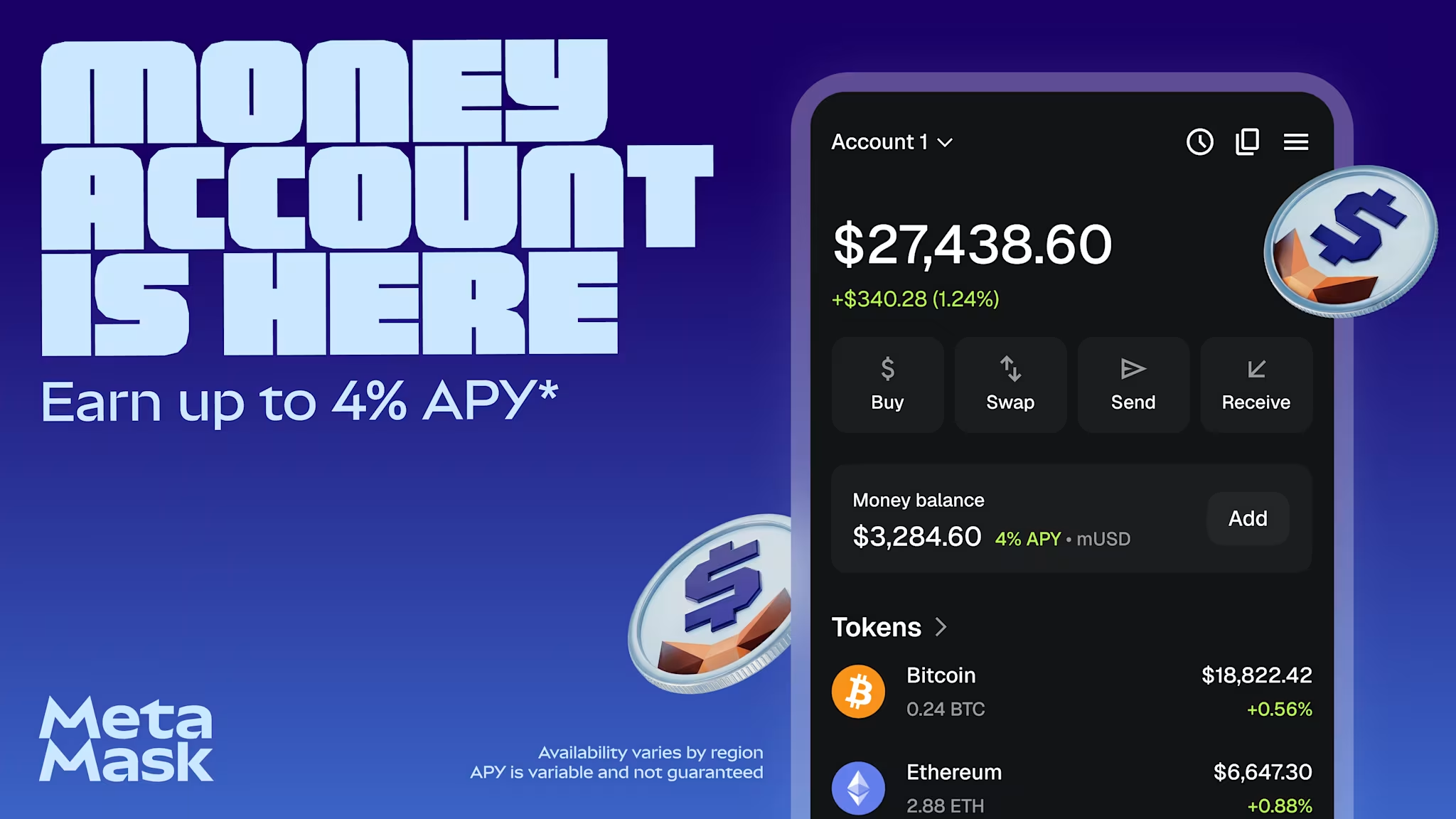
MetaMask launches Money Account, bringing DeFi yield and global spending to stablecoin balances
For the first time, users can earn up to 6% variable APY* on stablecoin balances and spend at hundreds of millions of merchants from a single self-custodial account, built on Monad.
- GUIDES

Top mobile crypto wallet apps in 2026
Compare the leading mobile crypto wallet apps across iOS and Android.
- GUIDES
Stablecoin vs bank account
Stablecoins and bank accounts both hold fiat value, but they operate on different infrastructure. This guide breaks down how protection, yield, transfer speed, and access differ.

