
MetaMask is the world's leading self-custodial crypto wallet and gateway to decentralized finance, built by Consensys.
Read all articles
A bitcoin exchange-traded fund (ETF) is an investment product that trades on a traditional stock exchange and tracks the price of bitcoin. ETF investors buy shares through a brokerage account, the same way they'd buy shares of a stock or index fund, without needing a crypto wallet, Private Keys, or direct interaction with the bitcoin network. The ETF issuer holds bitcoin (or bitcoin-linked derivatives) on behalf of shareholders.
Disclaimer: This guide is for educational purposes only. It is not financial advice, not a solicitation, and not for UK audiences. Bitcoin ETFs are risky and not suitable for all users.
How bitcoin ETFs work
A bitcoin ETF issuer purchases bitcoin and stores it with a regulated custodian. The fund then issues shares that represent fractional ownership of that bitcoin. Those shares are listed on a stock exchange—NYSE, Nasdaq, or Cboe—and trade throughout the day like any other security.
The share price tracks bitcoin's market price through a creation and redemption mechanism. Authorized participants (large financial institutions) create new ETF shares by delivering bitcoin to the fund, or redeem shares by withdrawing bitcoin. This arbitrage process keeps the ETF's share price closely aligned with the underlying asset's spot price.
Investors never touch bitcoin directly. They hold shares in a regulated fund, managed by a regulated issuer, traded on a regulated exchange. Custody, security, and compliance are handled by the ETF provider, not the investor.
Spot ETFs vs futures ETFs
Two types of bitcoin ETFs exist, and the distinction matters for cost and price tracking accuracy.
Spot bitcoin ETFs hold actual bitcoin. The fund's custodian stores BTC, and the share price reflects the real-time market price of Bitcoin minus fees. The SEC approved 11 spot bitcoin ETFs on January 10, 2024—a decision that followed more than a decade of rejected applications and was catalyzed by Grayscale's successful legal challenge in August 2023. Spot ETFs offer the most direct price exposure to bitcoin available through a traditional brokerage.
Futures itcoin ETFs hold Bitcoin futures contracts traded on the Chicago Mercantile Exchange (CME), not Bitcoin itself. Bitcoin futures ETFs were approved earlier; the first launched in October 2021. Because futures contracts expire and must be rolled into new contracts periodically, futures ETFs incur roll costs that create a performance drag over time. This means futures ETFs may underperform spot Bitcoin over longer holding periods.
Consideration | Spot bitcoin ETF | Futures bitcoin ETF |
What the fund holds | Actual bitcoin, stored by a regulated custodian | Bitcoin futures contracts on the CME |
Price tracking | Closely tracks Bitcoin's spot price | May deviate due to futures contango and roll costs |
SEC approval | January 10, 2024 (11 funds approved simultaneously) | October 2021 (first fund launched) |
Ongoing cost factor | Expense ratio only | Expense ratio plus futures roll costs |
Best suited for | Longer-term holding, direct price exposure | Short-term tactical positions |
Major spot Bitcoin ETFs
Since the launch of spot Bitcoin ETFs in January 2024, these instruments have attracted significant institutional capital. Cumulative net inflows reached approximately $55.66 billion as of late May 2026, according to CryptoTimes reporting on ETF flow data.
The market is concentrated among a few large issuers:
Fund | Ticker | Issuer | AUM (approx.) | Expense ratio |
iShares Bitcoin Trust | IBIT | BlackRock | $67 billion | 0.25% |
Wise Origin Bitcoin Fund | FBTC | Fidelity | $17 billion | 0.25% |
Morgan Stanley Bitcoin ETF | MSBT | Morgan Stanley | $233 million | 0.14% |
Grayscale Bitcoin Trust | GBTC | Grayscale | Declining (redemption pressure) | 1.50% |
AUM figures are approximate as of May 2026 and change daily with fund flows and Bitcoin's price. IBIT and FBTC together control the majority of institutional Bitcoin allocation through ETF vehicles. Morgan Stanley's MSBT, launched April 8, 2026, carries a 0.14% expense ratio, according to 24/7 Wall St. reporting.
Options trading on spot Bitcoin ETFs became available after the SEC approved exchange rule changes in September and October 2024. IBIT, GBTC, FBTC, ARKB, BTC, and BITB all now support options trading, enabling strategies like covered calls, protective puts, and spread positions.
Bitcoin ETF vs holding Bitcoin directly
A Bitcoin ETF and holding Bitcoin directly in self-custodial wallet are two fundamentally different ways to gain Bitcoin exposure. Neither is universally better; they optimize for different priorities.
What an ETF provides: regulated structure, familiar brokerage interface, no Private Key management, eligibility for tax-advantaged accounts (IRAs, 401(k)s), and institutional-grade custody handled by the fund provider.
What an ETF does not provide: direct ownership of Bitcoin. ETF shareholders hold shares in a fund—not Bitcoin itself. They can't send BTC to another address, use it in onchain applications, or withdraw it to a wallet. The investor is also exposed to the fund's expense ratio (typically 0.14%–0.25% annually for spot ETFs, 1.50% for GBTC) and to counterparty risk from the custodian and fund structure.
What self-custody provides: direct ownership of Bitcoin, full control via Private Keys, the ability to send, receive, and use BTC onchain, no ongoing expense ratio, and no reliance on a third-party custodian or fund structure.
What self-custody requires: managing a Secret Recovery Phrase, securing the wallet device, understanding Bitcoin address formats and network fees, and accepting that loss of the Secret Recovery Phrase means permanent loss of funds with no recovery option.
MetaMask supports native Bitcoin with SegWit addresses, allowing BTC to be held, sent, received, and swapped alongside Ethereum and Solana assets in a single self-custodial wallet. For a detailed comparison of Bitcoin wallet types, see what is a Bitcoin wallet.
Consideration | Bitcoin ETF | Self-custodial wallet |
What the holder owns | Shares in a fund | Bitcoin directly |
Custody | Fund provider (e.g., Coinbase Custody for IBIT) | The holder (Private Keys on their device) |
Ongoing cost | Expense ratio (0.14%–1.50% annually) | Network fees per transaction only |
Tax-advantaged accounts | Eligible (IRA, 401(k)) | Not eligible |
Onchain usage | Not possible | Send, receive, swap, use in apps |
Counterparty risk | Fund custodian, issuer solvency | None (self-sovereign) |
Recovery if access lost | Brokerage account recovery process | Secret Recovery Phrase only—no third-party recovery |
Risks of Bitcoin ETFs
Bitcoin ETFs carry risks beyond Bitcoin's own price volatility, including:
Expense ratio drag. Even low-fee spot ETFs often charge around 0.12%–0.25% annually, and over years of holding this compounds. A self-custodial holder pays no ongoing custody fee—only network fees per transaction.
Custodian risk. The fund's Bitcoin is held by a third-party custodian. If the custodian is compromised, insured recovery processes apply, but they aren't instantaneous and may not cover the full amount.
Tracking error. While spot ETFs track Bitcoin closely, small deviations occur due to management fees, rebalancing, and cash drag. Futures ETFs have significantly larger tracking errors due to roll costs.
Regulatory risk. ETF products operate under SEC jurisdiction. Regulatory changes—fee caps, trading restrictions, or structural requirements—could affect fund performance or availability.
No onchain utility. ETF shares can't be used in DeFi, sent to another party, or used as collateral in onchain protocols. The holder has exposure to Bitcoin's price, not to Bitcoin's network.
For a full explanation of how Bitcoin's network functions, see how Bitcoin works. To buy BTC directly in a self-custodial wallet, see how to buy Bitcoin.
- MetaMask

- GUIDES
DAI vs USDS: what's the difference?
Explore the DAI and USDS stablecoins, how they compare, how they differ, what they're used for, and how to convert.
- GUIDES

What is slippage?
Learn how slippage works, how to calculate it, and practical strategies traders use to minimize it.
- GUIDES
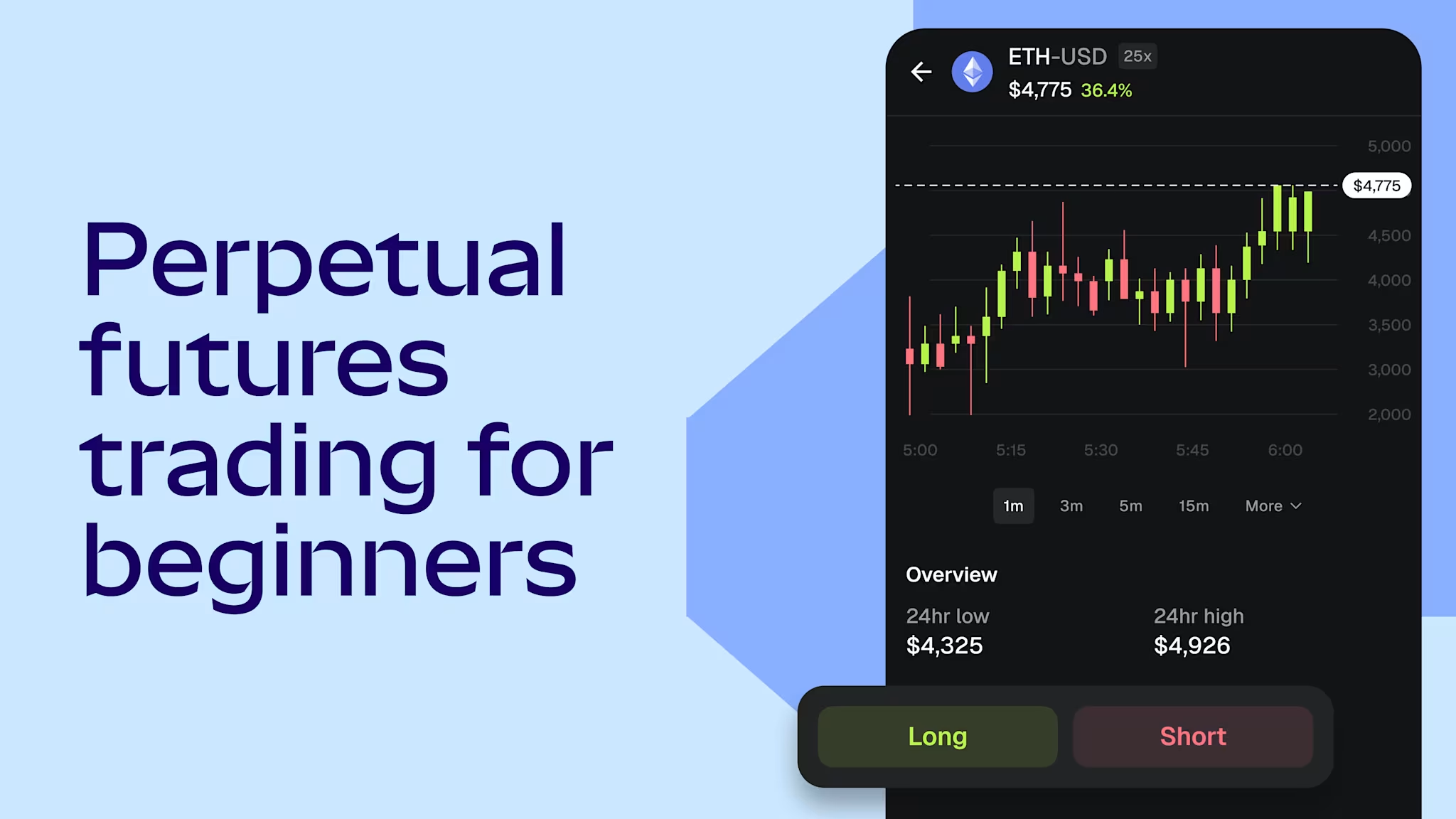
Perps trading for beginners
Learn what perpetual futures are, how they work, and what every new trader needs to understand before opening a position.
