
MetaMask is the world's leading self-custodial crypto wallet and gateway to decentralized finance, built by Consensys.
Read all articles
Key takeaways about Bitcoin futures trading
Spot trading means owning bitcoin (BTC), traditional futures offer time-limited price exposure with an expiry date; perpetual futures provide continuous leveraged exposure with no expiry, using funding rates to track spot prices.
Global crypto derivatives volume reached approximately $85.7 trillion in 2025. Decentralized exchanges (DEXs) offering perps processed $6.7 trillion of that, a 346% year-over-year increase.
The CFTC regulates Bitcoin futures in the US, requiring exchanges to register as designated contract markets with segregated client funds and market surveillance.
Institutional adoption has deepened through spot bitcoin ETFs, corporate bitcoin treasury accumulation, and the US government's Strategic Bitcoin Reserve executive order.
Self-custodial access to perpetual futures, through integrations like MetaMask Perps via Hyperliquid, now allows blockchain derivatives trading without centralized exchange (CEX) accounts or KYC.
Bitcoin can be traded in several ways, each with different mechanics, risks, and ownership implications. Spot trading means buying and holding actual BTC. Standard futures—offered by regulated exchanges like CME since 2017—are contracts that expire on a set date and settle in cash or bitcoin. Perpetual futures, the dominant derivative by volume, work like futures but never expire—instead using a funding rate mechanism to stay anchored to spot prices. Each serves a different purpose: spot for direct ownership, standard futures for time-bound hedged exposure, and perpetual futures for continuous leveraged positioning.
The scale of derivative markets trading volume reflects rapidly growing adoption. Global crypto derivatives volume reached approximately $18.63 trillion in the first quarter of 2026. CME Group's crypto futures and options averaged 407,200 contracts per day in early 2026, up 46% year-over-year. Decentralized finance (DeFi) platforms averaged about $611.57 billion per month across the top perp DEXs in the first four months of 2026. This article explores spot BTC, traditional futures, and perpetual futures trading by trends, data, and regulations.
Disclaimer: This guide is for educational purposes only. It isn't financial advice, not a solicitation, and not for UK audiences. Bitcoin futures trading is risky and not suitable for all users.
Bitcoin futures vs perpetual futures vs spot: key differences
Spot trading means buying and owning the actual bitcoin asset, held in a wallet, with no leverage, no liquidation risk, and no funding cost. The position lasts as long as the holder wants, and the asset can be transferred, staked, or used in DeFi protocols.
Standard futures are contracts with fixed expiration dates where settlement occurs in cash or BTC at expiry. These are the traditional derivatives products offered by centralized exchanges like CME since 2017. Traders don't own the underlying bitcoin; they hold a margin-based agreement that settles at a future date. The price of a standard futures contract naturally converges with spot as expiry approaches.
Perpetual futures work differently. They have no expiry date, so there's no settlement convergence event. Instead, a periodic funding rate, a small payment exchanged between long and short holders, typically every eight hours, keeps the contract price anchored near spot. Perpetuals have become the dominant crypto derivative by volume because they combine the leverage of futures with the continuity of spot. There are no rollovers and no expiry-driven price distortions. For a primer on how funding rates, leverage, and liquidation work, explore fundamental perpetual futures concepts.
The key distinction across all three: spot means ownership, standard futures mean time-limited price exposure, and perpetual futures mean continuous price exposure, with leverage and funding costs in exchange for no expiry. For a deeper comparison of perpetual futures versus spot specifically, see the guide to perpetual futures vs spot bitcoin trading.
Feature | Standard futures | Perpetual futures | Spot BTC |
Expiry | Fixed (monthly or quarterly) | None | N/A |
Settlement | Cash or BTC at expiry | Continuous via funding rate | Immediate ownership |
Leverage | Yes (margin-based) | Yes (margin-based) | No |
Ownership of BTC | No | No | Yes |
Funding cost | None (cost embedded in basis) | Periodic funding payments | None |
Typical centralized exchange | CME | Coinbase Derivatives, Binance, Bybit | Coinbase, Kraken, Gemini |
How bitcoin futures are regulated in the US
Bitcoin futures regulation varies significantly by jurisdiction. The US has a developed framework for Bitcoin futures regulated by the CFTC, with CME as a key player serving global institutions, influencing market structure internationally.
The Commodity Futures Trading Commission (CFTC) is the primary US federal regulator, classifying bitcoin as a commodity and requiring futures exchanges to register as designated contract markets (DCMs). This structure provides segregation of client funds, uniform federal licensing (unlike state-by-state money transmitter rules for spot exchanges), market surveillance, and position reporting consistent with the Commodity Exchange Act. Futures markets also aren't subject to the Financial Industry Regulatory Authority's pattern day trader rule, which affects accessibility for active participants in equity markets.
Category | Regulated US venues (DCMs) | Unregulated offshore venues |
Oversight | CFTC and National Futures Association (NFA) compliant | Minimal or no oversight |
US resident access | Permitted | Often restricted or technically prohibited |
Client fund custody | Segregated, institutional-grade | Platform-managed, commingled risk |
Licensing | Designated contract market registration | Varies; often lacking US registration |
Regulated US venues (DCMs) are overseen by the CFTC and NFA with segregated client funds and designated contract market registration, contrasting unregulated offshore venues. In March 2026, the SEC and CFTC issued joint guidance clarifying crypto asset regulation under federal laws, signaling coordinated approaches.
Institutional bitcoin futures adoption: ETFs, corporate treasuries, and CME trends
In April 2026, bitcoin ETFs charted $1.7B weekly inflows. By July 2026, inflows had cooled: US spot Bitcoin ETFs logged a third consecutive weekly inflow of $33.79 million in the week ended July 24, 2026, following a roughly two-month outflow stretch.
Publicly traded companies reported combined holdings of approximately 1,263,199 BTC as of July 2026—a value of $80.07 billion—according to BitcoinTreasuries.net. The US government formally established a Strategic Bitcoin Reserve via executive order on March 6, 2025, signaling sovereign custody intent rather than liquidation.
CME crypto futures average daily volume reached a record $12 billion in notional value in 2025, a 139% rise from 2024. CME moved its regulated crypto futures and options to continuous 24/7 trading on May 29, 2026, eliminating the "CME gap" where weekend price movements created visible gaps in Monday's charts.
Decentralized perpetual futures: how perp DEXs are reshaping the market
The most dramatic structural shift in the derivatives market has been the growth of decentralized perpetual futures exchanges (perp DEXs), where traders open leveraged positions onchain through self-custodial wallets without intermediaries. The top 12 perp DEX venues averaged roughly $611.57 billion per month in the first four months of 2026. DEX market share of perpetual futures volume was roughly 10% as of April 2026.
Hyperliquid, a purpose-built Layer 1 for derivatives trading, recorded approximately $2.9 trillion in volume in 2025 and controlled roughly 70% of all onchain perpetual futures volume. As of July 2026, Hyperliquid's 30-day perpetual volume exceeded $180 billion, according to DefiLlama. Perp DEXs are no longer limited to crypto assets—platforms now offer perpetual contracts on gold, silver, foreign exchange pairs, and tokenized equity indices. Self-custodial wallet integrations like MetaMask Perps connect users directly to this onchain derivatives infrastructure without requiring a centralized exchange account.
Bitcoin futures risks: leverage, liquidation, and market structure
Following a February 2026 dip in value, BTC futures open interest dropped from roughly $61 billion to approximately $49 billion—a decline of more than 20%—according to VanEck's analysis. By late April 2026, open interest had recovered toward $50 billion, with funding rates remaining negative despite a 14% price rally. Several structural issues continue to shape the bitcoin futures market globally. Regulatory frameworks vary significantly across jurisdictions, meaning margin rules, reporting requirements, and consumer protections differ between regulated and offshore contracts. Liquidity is distributed across many venues with different settlement standards, affecting order book depth for large trades. Competing stablecoin issuers and technical standards slow interoperability across futures venues. While institutional participants generally cap leverage well below exchange maximums, retail-heavy offshore markets still see cascading liquidation events during sharp moves—for example, roughly $1 billion in leveraged crypto positions was liquidated in a single 24-hour stretch on June 25, 2026 as bitcoin fell to its lowest level of the year.
- MetaMask

- GUIDES

Bitcoin vs Ethereum: what's the difference?
Bitcoin and Ethereum are the two largest crypto blockchain networks, but they were built for different purposes. Explore how they compare.
- DEVELOPERS
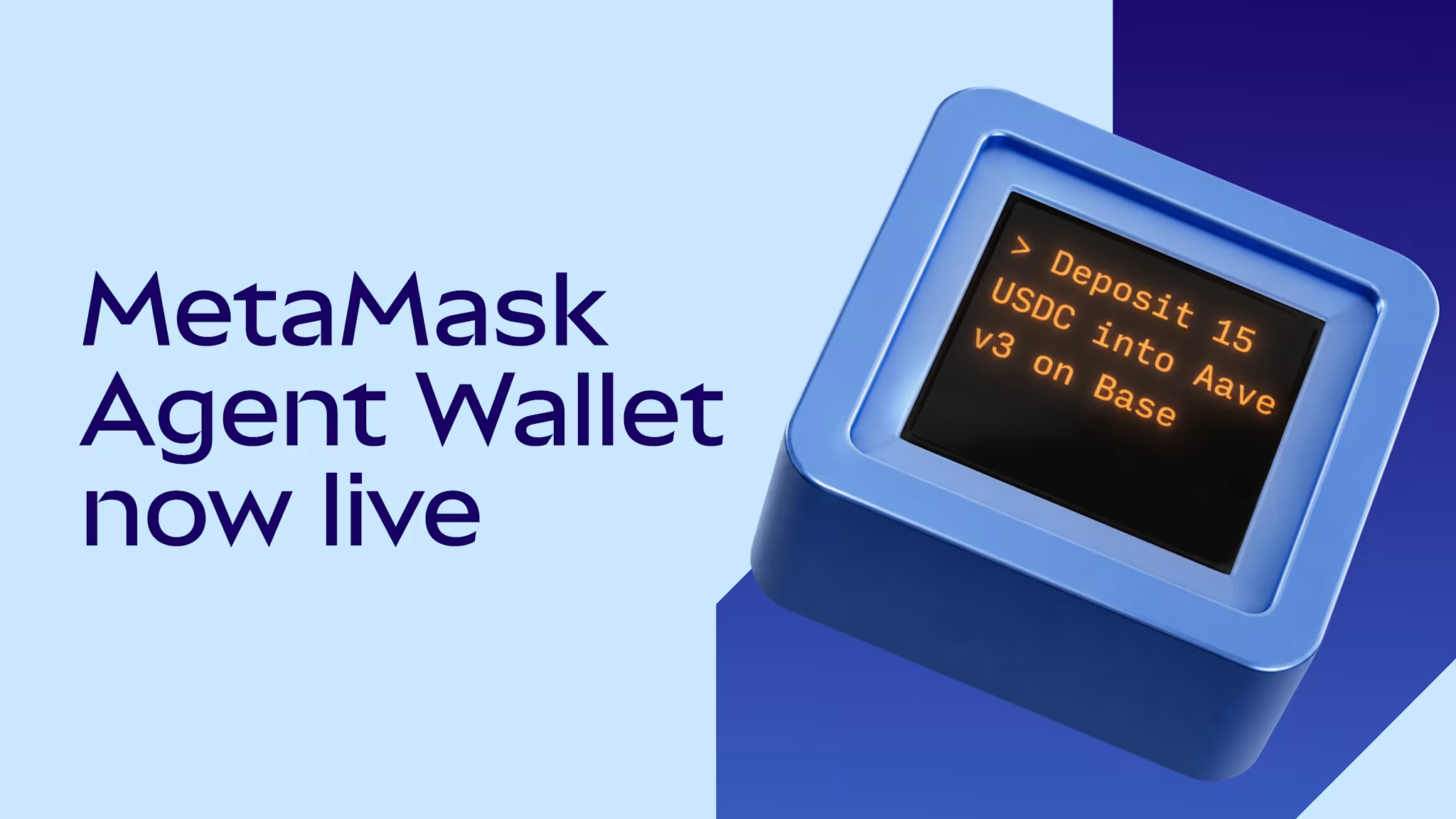
MetaMask Agent Wallet is now live
Set spend limits, allowlist protocols, and pick Guard Mode or Beast Mode, then let your agent execute behind threat scanning and MEV protection. No native gas token needed.
- GUIDES
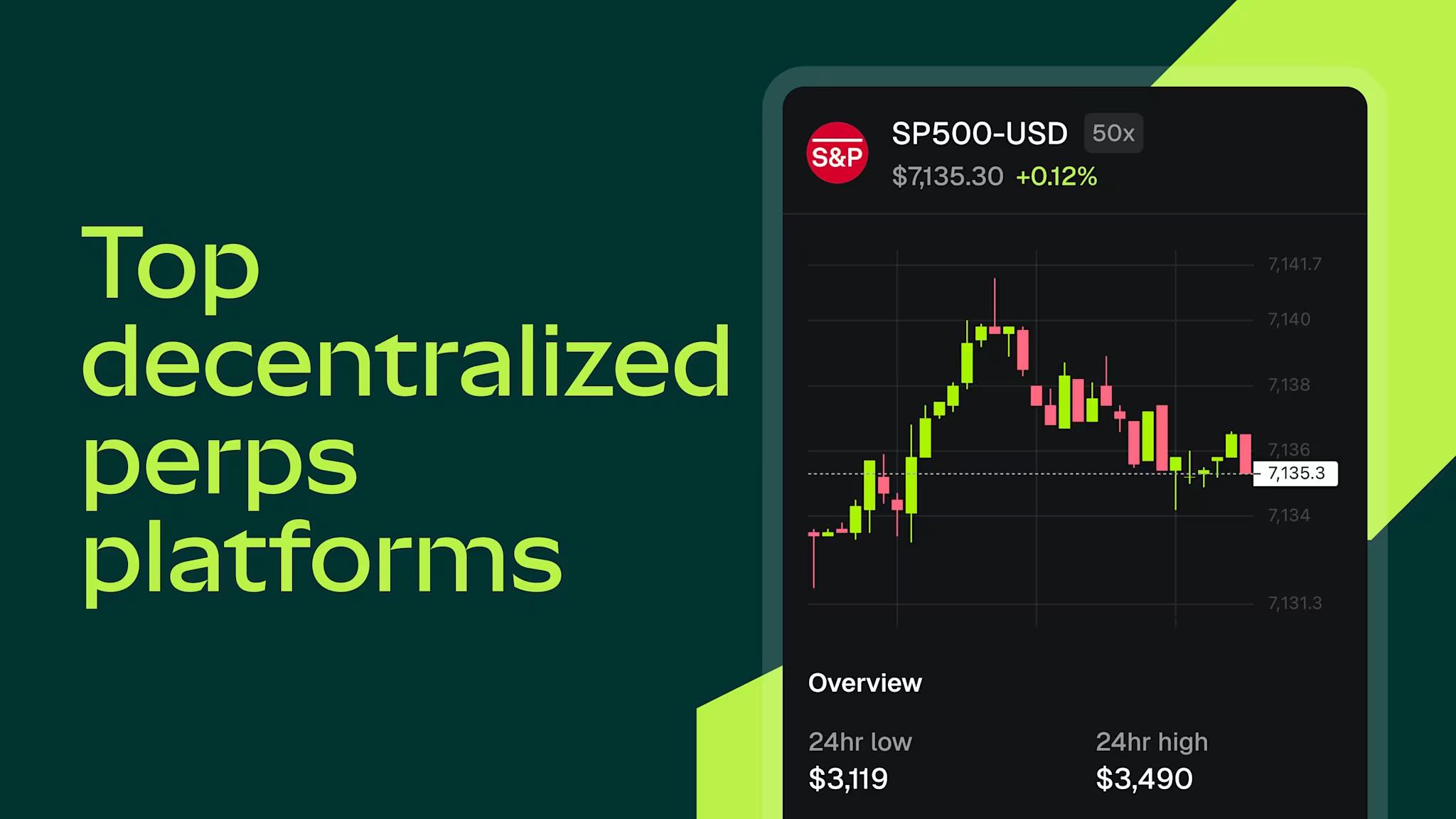
Top perps DEXs in 2026
Top perps DEXs in 2026 Excerpt: Hyperliquid, Aster, Lighter and more: how the leading onchain perps venues compare on volume, fees, and design.
