
MetaMask is the world's leading self-custodial crypto wallet and gateway to decentralized finance, built by Consensys.
Read all articles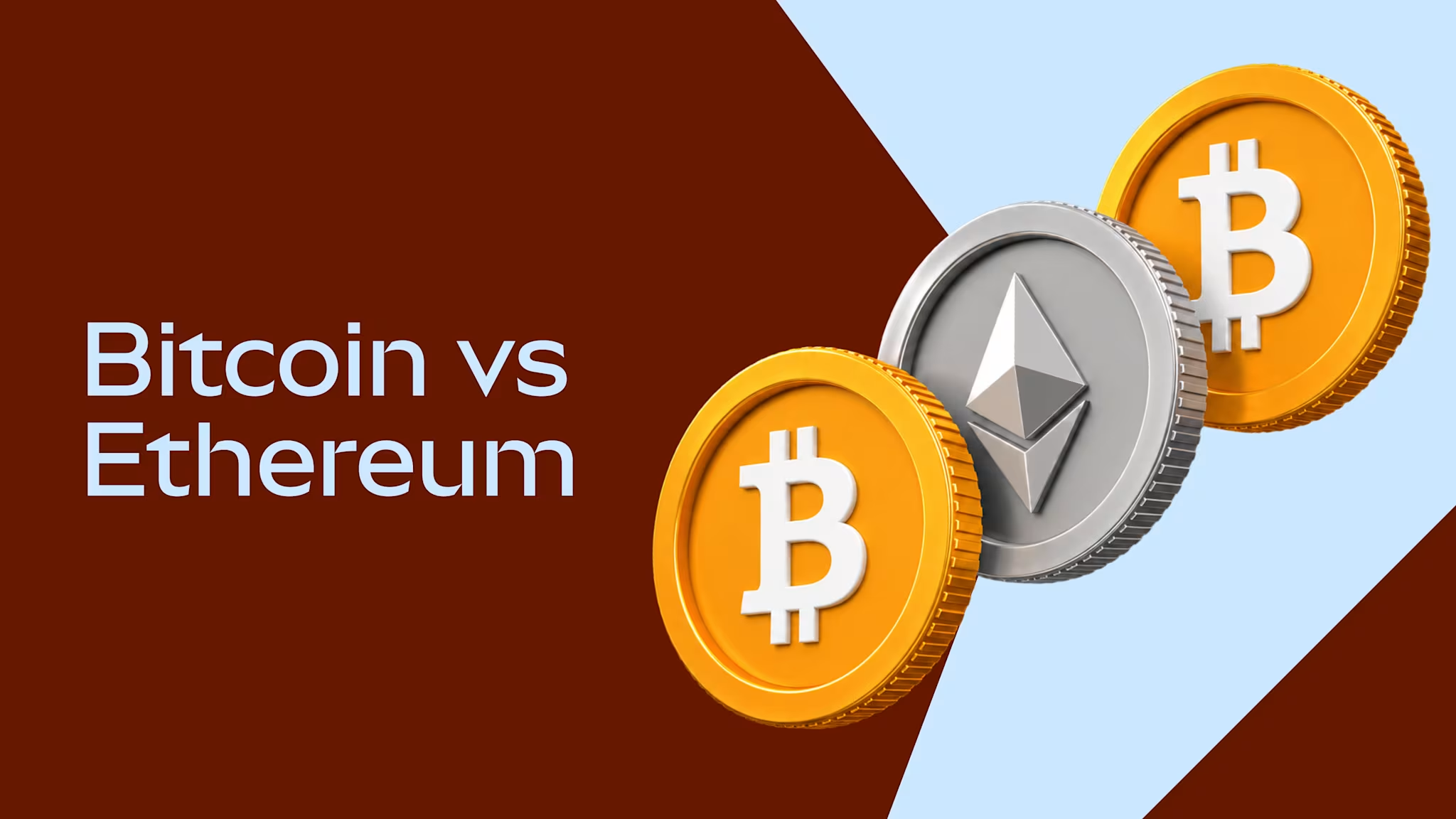
Bitcoin and Ethereum are the two largest blockchain networks, and their native tokens—BTC and ETH—are the two largest crypto assets by market cap. Both names pull double duty: 'Bitcoin' refers to the network and, in everyday usage, the token. The same goes for 'Ethereum,' though the token is technically called ether. This guide uses the full name when referring to the network and the ticker for the token.
Bitcoin, launched in 2009, is a decentralized payment network; BTC, its native token, is a scarce digital asset with a hard cap of 21 million coins. Ethereum, launched in 2015, is a programmable blockchain that runs smart contracts—the software behind decentralized finance (DeFi), stablecoins, tokenized assets, and a wide network of Layer 2 chains. In short, Bitcoin optimizes for scarcity, security, and predictability, while Ethereum optimizes for programmability and flexibility. Both use decentralized networks of computers to validate transactions without a central authority, but they differ in four main ways: consensus mechanism, accounting model, supply policy, and the kinds of applications they can run. This comparison keeps the definitions of Bitcoin and Ethereum intentionally brief, to focus on how they diverge. See how Bitcoin works for a deep dive into the network. Disclaimer: This guide is for educational purposes only. It is not financial advice, not a solicitation, and not for UK audiences. Prediction markets are risky and not suitable for all users.
What is Bitcoin?
Bitcoin is the original cryptocurrency, introduced in a 2008 white paper by the pseudonymous Satoshi Nakamoto and launched when the genesis block was mined on January 3, 2009. Its purpose is narrow by design: a decentralized, scarce digital money and store of value, often described as digital gold. No single company, foundation, or government controls it; the network is maintained by thousands of independent nodes and miners running open-source software, and protocol changes are proposed through Bitcoin Improvement Proposals (BIPs) and adopted only if node operators and miners choose to run the updated software. Satoshi's identity remains unknown, and Satoshi stepped away from public development around 2010, leaving maintenance to a distributed community of developers, including those behind Bitcoin Core, the reference client.
Bitcoin's use cases center on holding, long-term saving, and cross-border payments. Its scripting language is deliberately limited compared with Ethereum's, which keeps the protocol simple and reduces the attack surface, but also means Bitcoin isn't designed as a general-purpose application platform. For a fuller walkthrough, see the how Bitcoin works guide linked below.
What is Ethereum?
Ethereum is a programmable blockchain proposed by Vitalik Buterin in a 2013 white paper and launched on July 30, 2015. Unlike Bitcoin, it was designed from the outset to run arbitrary code onchain through smart contracts, self-executing programs that power lending markets, exchanges, stablecoins, NFT marketplaces, DAOs, and thousands of other apps. Ethereum's native token, ether (ETH), pays network fees, denominated in gwei (a subunit of ETH), and rewards the validators who secure the network.
Ethereum's early development was coordinated in large part by the Ethereum Foundation, a Swiss nonprofit established in 2014, though the protocol is open source and maintained collaboratively by client teams, researchers, and independent contributors. As with Bitcoin, changes go through a public proposal process, called Ethereum Improvement Proposals (EIPs), and require broad agreement among node operators, validators, and app developers before a network upgrade adopts them. Ethereum is used by individuals holding ETH and tokens, developers building apps, and institutions settling tokenized assets and stablecoins, either on its base layer or on the Layer 2 networks built on top of it.
A brief timeline of the Bitcoin and Ethereum networks
Bitcoin and Ethereum have taken different paths since launch, each marked by distinct technical milestones.
Bitcoin's history:
2008: The Bitcoin white paper is published under the name Satoshi Nakamoto.
January 3, 2009: The genesis block (block 0) is mined, launching the network.
November 28, 2012: The first halving cuts the block reward from 50 BTC to 25 BTC.
July 9, 2016: The second halving cuts the reward from 25 BTC to 12.5 BTC.
August 2017: The SegWit upgrade activates, restructuring transaction data to increase effective block capacity and fix transaction malleability.
May 11, 2020: The third halving cuts the reward from 12.5 BTC to 6.25 BTC.
November 2021: The Taproot upgrade activates, improving privacy and enabling more complex spending conditions.
April 20, 2024: The fourth halving cuts the reward from 6.25 BTC to 3.125 BTC per block.
Early 2024: Spot Bitcoin ETFs launch in the US, expanding institutional access.
~2028 (projected): The fifth halving is expected to cut the reward to 1.5625 BTC per block.
Ethereum's history:
2013: Vitalik Buterin publishes the Ethereum white paper.
July 30, 2015: Ethereum's mainnet launches (the "Frontier" release).
2016: The DAO hack and a subsequent hard fork split the chain into Ethereum (ETH) and Ethereum Classic (ETC).
2017–2019: Upgrades including Byzantium and Istanbul add privacy and efficiency improvements.
December 2020: The Beacon Chain launches, beginning Proof of Stake in parallel with the existing Proof of Work chain.
August 2021: EIP-1559 activates in the London upgrade, introducing a base-fee burn.
September 15, 2022: The Merge combines the Beacon Chain with Ethereum's execution layer, ending Proof of Work and cutting the network's energy use by about 99.95%, according to ethereum.org.
April 2023: The Shapella upgrade enables staked-ETH withdrawals for the first time.
March 2024: The Dencun upgrade introduces proto-danksharding (EIP-4844) and "blobs," cutting data costs for Layer 2 rollups.
May 2025: The Pectra upgrade raises the maximum per-validator balance to 2,048 ETH (EIP-7251) and introduces EIP-7702 for smart-account features on regular wallets.
December 3, 2025: The Fusaka upgrade activates, introducing PeerDAS and expanding blob capacity to improve Layer 2 scaling, as ethereum.org's history records.
Second half of 2026 (planned): The "Glamsterdam" upgrade is in development, expected to include enshrined proposer-builder separation (EIP-7732) and block-level access lists (EIP-7928), with no activation date finalized as of mid-2026, per CoinDesk.
Accounting models
Bitcoin uses the UTXO model, short for unspent transaction outputs, which works like physical cash: a wallet's balance is the sum of discrete "coins" it holds, and spending combines and splits those outputs into new ones. There's no single running balance stored anywhere, since a wallet's balance is calculated by scanning for the UTXOs tied to its addresses.
Ethereum uses an account model, closer to a bank ledger: each address has a balance, and contract accounts also have their own storage. This maps more naturally onto smart contracts, which often need to track ongoing state, such as a lending position's collateral ratio, a token's total supply, or a DAO's voting record, rather than just discrete transfers.
Consensus mechanisms
Bitcoin uses Proof of Work, in which miners compete to solve a cryptographic puzzle, and the winner adds the next block and receives the block reward plus transaction fees. This ties security to real-world energy and hardware spending, and Bitcoin's difficulty adjusts roughly every two weeks to keep block production near a 10-minute average.
Ethereum used Proof of Work until the Merge on September 15, 2022, when it switched to Proof of Stake. Under Proof of Stake, validators lock up (stake) ETH as collateral, a minimum of 32 ETH to run a solo validator, and are randomly selected to propose and attest to blocks. Validators who act dishonestly can have part of their stake destroyed, a penalty called slashing. The switch cut Ethereum's energy use by about 99.95%, per ethereum.org, since the network no longer needs mining hardware competing on raw computation.
Block time is one of the more visible day-to-day differences. Bitcoin targets a new block roughly every 10 minutes, while Ethereum produces one every 12 seconds under Proof of Stake, since a validator is assigned to each fixed 12-second "slot," as ethereum.org explains. That faster cadence is one reason Ethereum can confirm base-layer transactions sooner, though both networks recommend waiting for multiple confirmations on high-value transactions to reduce the risk of a chain reorganization, where the most recent blocks are replaced by a competing version of the chain.
Smart contracts and programmability
Ethereum's core innovation is the Ethereum Virtual Machine (EVM), which lets developers deploy arbitrary programs onchain. Smart contracts on Ethereum enable decentralized exchanges, lending protocols, stablecoins, NFT marketplaces, DAOs, and tokenized real-world assets, an ecosystem since replicated by dozens of other EVM-compatible networks.
Bitcoin's scripting language, Bitcoin Script, is intentionally non-Turing-complete, meaning it can't run loops or arbitrary logic. That's a deliberate security and simplicity trade-off rather than an oversight, since it narrows the ways the protocol can fail or be exploited. Some functionality resembling smart contracts exists through layers built on top of the base protocol, such as the Lightning Network for fast, low-cost payments and newer protocols like Ordinals and BRC-20 tokens that inscribe data into Bitcoin's block space. These remain more limited than Ethereum's general-purpose contract environment, and adoption of Bitcoin-based token standards is far smaller than Ethereum's app ecosystem. This gap in programmability is the defining technical distinction between the two networks.
Supply policy
BTC has a fixed cap of 21 million coins, enforced by the Bitcoin protocol's code. New BTC enters circulation only through block rewards, which are cut in half roughly every four years (every 210,000 blocks) at an event called the halving. As of July 2026, roughly 20.06 million BTC are in circulation, about 95.5% of the eventual maximum, according to Blockchain.com, with the block reward at 3.125 BTC following the April 2024 halving. The last new bitcoin is projected to be mined around the year 2140. See what is Bitcoin halving for more on how the process works.
ETH has no fixed supply cap. New ETH is issued to validators as a staking reward, but since the London upgrade in August 2021, part of every transaction's fee, the base fee, is burned (permanently removed from circulation) under EIP-1559 rather than paid to validators. Only the separate "priority fee," or tip, goes to the validator that proposes the block. When network activity is very high, the ETH burned can exceed the ETH issued, briefly making net issuance negative, a dynamic proponents call "ultrasound money," though across 2024 to 2026 ETH's supply has grown modestly on net as more activity moved to Layer 2s. As of July 2026, circulating supply is about 120.7 million ETH, with more than 4.6 million ETH burned since EIP-1559 activated, per Etherscan, and roughly a third of circulating ETH was staked by validators as of mid-2026, based on beaconcha.in data.
BTC vs ETH: Market cap and adoption
BTC has held the largest market cap among crypto assets since inception, with ETH in second place for most of its history. As of July 2026, BTC's market cap sits at roughly $1.3 trillion against Ethereum's roughly $220 billion, so ETH's market cap is around 17% of Bitcoin's, according to CoinGecko. BTC's dominance, meaning its share of the total crypto market cap, was about 56% as of mid-2026, while ETH's was around 9%, per CoinGecko's dominance chart. Both figures move significantly with market conditions and are worth checking live.
BTC's all-time high was $126,080 on October 6, 2025, and Ethereum's was $4,946.05 on August 24, 2025, according to CoinGecko. Both networks have since traded well below those peaks, consistent with the volatility typical of crypto assets.
Ecosystems built on Bitcoin and Ethereum networks
Bitcoin's base layer is intentionally minimal, so most ecosystem growth happens on secondary layers. The Lightning Network is the most widely used, enabling near-instant, low-fee Bitcoin payments through off-chain payment channels that settle back to the base chain. Sidechains and newer inscription-based token standards have added limited programmability, but Bitcoin's ecosystem stays smaller and more narrowly scoped than Ethereum's.
Ethereum's ecosystem centers on Layer 2 (L2) scaling networks: rollups that execute transactions off Ethereum's base layer, whcih si considered Layer 1 (L1), and post compressed transaction data back to it, inheriting much of Ethereum's security while offering lower fees and faster confirmation. As of July 2026, the total value secured across Ethereum's Layer 2 networks was roughly $35 billion, according to L2BEAT, with Base and Arbitrum the two largest at roughly $12 billion and $11 billion, together about two-thirds of the total. Smaller zero-knowledge rollups such as Starknet, Linea, and zkSync Era hold distinct positions, using zero-knowledge proofs rather than the fraud-proof model of optimistic rollups like Arbitrum and Optimism. Ethereum's L2s support the same broad set of use cases as its base layer, at lower cost, and both L1 and L2 assets can be viewed and managed in a self-custodial wallet such as MetaMask, which supports Ethereum mainnet, EVM, as well as all major blockchain networks, including Bitcoin.
Why the differences between Bitcoin and Ethereum matter
Bitcoin and Ethereum reflect different design priorities, and those priorities carry through to how each network is used. BTC's minimal, hard-to-change protocol and fixed supply cap are meant to make it predictable and resistant to sudden policy changes, properties that matter for something positioned as a long-term store of value. ETH's programmability trades some of that simplicity for flexibility, allowing an ecosystem of financial applications, tokens, and infrastructure be built directly on the network without a separate, centralized platform.
Neither design is strictly better; Bitcoin and Ethereum serve different goals. Someone mainly interested in holding a scarce, well-established digital asset may lean toward BTC's simplicity, while someone interested in using or building applications, such as lending, trading, tokenized assets, preps, predictions, is more likely to hold ETH, and interact with Ethereum or one of its Layer 2 networks. Many traders and builders use both, since the two aren't mutually exclusive, though Bitcoin and Ethereum are separate networks with separate address formats and aren't directly interoperable without a bridge, a wrapped-asset mechanism, or a multichain wallet like MetaMask.
Comparison of Bitcoin vs Ethereum
Attribute | Bitcoin | Ethereum |
Launched | January 3, 2009 | July 30, 2015 |
Founder(s) | Satoshi Nakamoto (pseudonymous) | Vitalik Buterin, Joe Lubin, and co-founders |
Primary purpose | Digital money, store of value | Programmable platform |
Accounting model | UTXO | Account-based |
Consensus | Proof of Work | Proof of Stake (since Sept. 2022) |
Average block time | ~10 minutes | ~12 seconds |
Smart contracts | Limited (Bitcoin Script) | Full support (EVM) |
Supply policy | Capped at 21 million; halving every ~4 years | No cap; issuance partly offset by EIP-1559 burn |
Circulating supply (as of July 31 2026) | ~20.06 million BTC | ~120.7 million ETH |
Market cap (as of July 31 2026) | ~$1.3 trillion | ~$220 billion |
Major scaling layers | Lightning Network | Arbitrum, Base, Optimism, and other L2 rollups |
Signature use cases | Holding, payments, savings | DeFi, stablecoins, NFTs, tokenized assets, apps |
Source: Supply figures from Blockchain.com and Etherscan; market caps from CoinGecko, July 31 2026. Market figures are point-in-time and fluctuate.
- MetaMask

- DEVELOPERS
MetaMask Agent Wallet is now live
Set spend limits, allowlist protocols, and pick Guard Mode or Beast Mode, then let your agent execute behind threat scanning and MEV protection. No native gas token needed.
- GUIDES

Top perps DEXs in 2026
Top perps DEXs in 2026 Excerpt: Hyperliquid, Aster, Lighter and more: how the leading onchain perps venues compare on volume, fees, and design.
- GUIDES

Prediction markets in 2026: Key trends reshaping forecasting, trading, and regulation
Explore major prediction market trends in 2026 including Polymarket's CFTC approval, AI trading, sports contracts, evolving global regulations, and more.
